“A Room With A View: In Santa Croce with No Baedeker,” Florence

“It was pleasant to wake up in Florence….to fling wide the windows, pinching the fingers in unfamiliar fastenings, to lean out into sunshine with beautiful hills and trees and marble churches opposite, and close below, the Arno, gurgling against the embankment of the road.”
IMG_5842

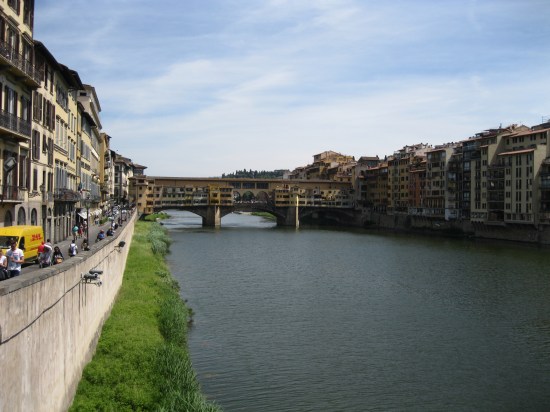
Lucy and Charlotte’s pensione, the Bertolini, would be much further down the river, past the Ponte Vecchio depicted here in this image. Past, even, the Uffizi, which lies beyond.  Forster set the Bertolini on the edge of the area now frequented by most tourists — or at least by me — from what I could tell from the description of Lucy’s outing in this chapter.

After awaking and having a tiresome scene with the ever-passive aggressive Miss Bartlett, Lucy finds an enthusiastic guide to the Santa Croce church in the “clever lady” Miss Lavinia Lavish. Miss Lavish eschews the Baedeker’s guide, the Bible of all Grand Tourists. “”He does but touch the surface of things!” she proclaims. Indeed, he does, but the Baedeker’s guide made such a tour more accessible to the middle classes so parodied by Forster, Twain, and other writers, who, in turn, are parodied in the figure of Miss Lavish.

Thanks to digital humanities projects, we travelers today can take a look at the Baedekers used by those nineteenth century Grand Tourists.  When you read them, with their recommendations for restaurants and pensiones and hotels, as well as their histories of the cities and countries on the tour, you feel a kinship if you have ever turned to a Lonely Planet or Top Ten or any other of today’s travel guides that you use to orient yourself in a strange land, especially one in which you do not speak the native language. If you use your imagination and think that, in the nineteenth century, they had much less information and much less cultural globalization, you can feel even a greater sense of adventure and alienation in stepping into those distant places. Forester mocks these tourists a bit, with their Baedekers and their Anglican minister tour guides like Rev. Eager and their very English pensione, but like my need for a very large coffee, travel can be disorienting. You want to orient yourself however you can, and sometimes you need a touchstone.

Maybe I’m being hard on Forester in mocking the Baedeker crowd. He  does, after all, later show the elder Mr. Emerson sympathizing with Lucy in the loss of her Badekker. When Lucy complains that “‘Miss Lavish has even taken away Badeker.” Mr. Emerson — who will always be the darling Denholm Elliot in my mind, thanks to the film — replies, “‘I’m glad it’s that you minded. It’s worth minding, the loss of Baedker. That’s worth minding.” Sure, Mr. Emerson seems teasing, but he’s kindly teasing, and understands.

Back to the beginning of Lucy’s outing. She and the Baedeker-confiscating Miss Lavish start out on their journey, with Miss Lavish’s promise, “‘I will take you the dirty back way, Miss Honeychurch, and if you bring me luck, we shall have an adventure.'”  “Adventure” is a word that can be used much like the American Southern expression, “bless your heart.” Lucy, in her youth and naivete, makes the mistake of thinking this will be joyful. As the entirety of the novel demonstrates, adventure might be “very interesting” and exciting, but it is  not always joyful. Quite often it is confusing and painful and can cause you to make disastrous decisions because they feel familiar and safe.

So, what happens when Lucy relies upon Miss Lavish?

“Miss Lavish — for that was the clever lady’s name — turned to the right along the sunny Lung’Arno. How delightfully warm! But a wind down the side streets cut like a knife, didn’t it? Ponte alle Grazie — particularly interesting, mentioned by Dante. San Miniato — beautiful as well as interesting; the crucifix that kissed a murderer — Miss Honeychurch would remember the story….”
IMG_6010

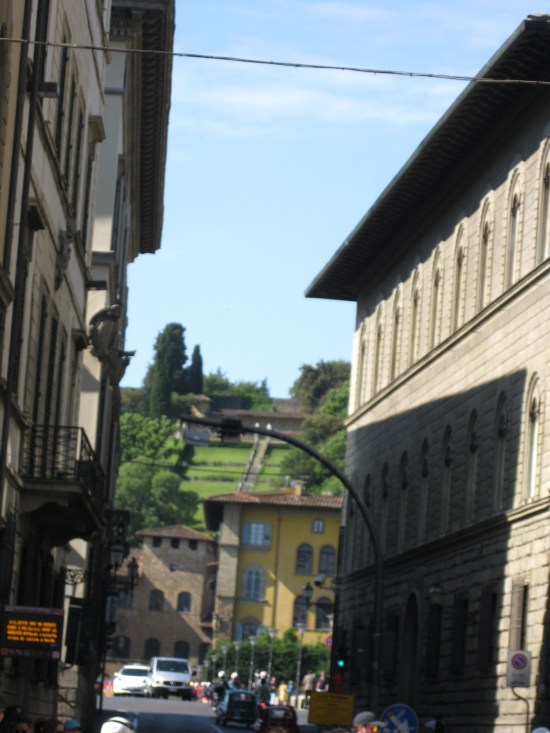
Alas! As Miss Lavish points out the site across the river, then instructs Lucy to inhale “a true Florentine smell!” she entirely misses the turn to Santa Croce, which would be down this very street.  They end up wandering and wandering, discussing matters of home, which do always seem to intrude, even when you are abroad and especially if you run into people from home.

At least, in my experience, those matters can seem so far away and less urgent, or perhaps that is a testament to my own powers of denial as long as I keep moving. Indeed, at some point on this trip, in Florence, I understood the reason that so many poets and writers and artists left home to seek refuge in places like Italy. Sometimes you have to step outside of your own life to feel alive. You have to feel alive to find your way back to that place in your head or your being that allows you to create.

In this novel, Lucy’s makes a journey of a young and repressed woman. She must find her way to simply feeling alive. This wandering with Miss Lavish begins that journey. They, of course, end up far off course, and fortifying themselves on some vile concoction that “tasted partly of the paper in which it was wrapped, partly of hair oil, partly of the great unknown.” Yet, Lucy did have one revelation.

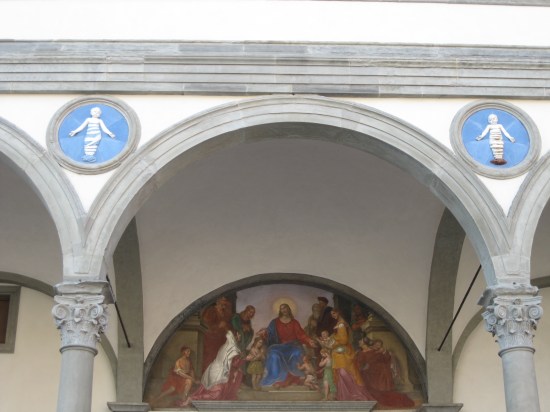
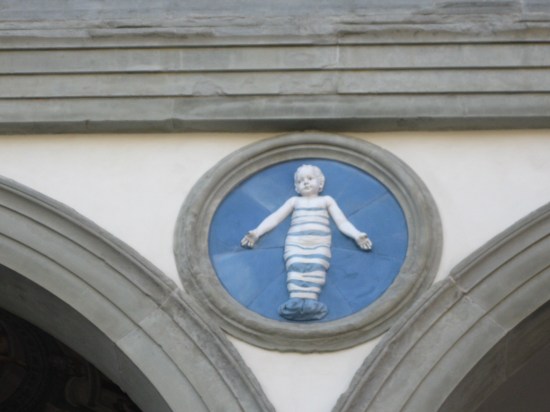
“For one ravishing moment Italy appeared. She stood in the square of the Annunziata and saw in the living terra-cotta those divine babies whom no cheap reproduction can every stale. There they stood, with their shining limbs bursting from the garments of charity and their strong white arms extended against circlets of heaven. Lucy thought she had never seen anything more beautiful….”
IMG_5900

I confess that was not how I saw them. Twee, sentimental, innocuous — all of these words came to mind. I also thought that, perhaps, this is the sort of thing a pleasant but unremarkable young woman like Lucy would like. In the next chapter, Mr. Beebe describes her as “only a young lady with a quantity of dark hair and a very pretty, pale, undeveloped face. She loved going to concerts, she loved stopping with her cousin, she loved ice coffee and meringues. He did not doubt that she loved his sermon also.” Of course she likes babies, too.

I wondered also, if this passage were also telegraphing her future. After all, as I thought about the ending of the book (is it really a spoiler to reveal the ending of a book that is over a century old, adapted as a movie that is now over 30 years old?), I thought it rather sad that perhaps this story is the high point of Lucy’s life and the most exciting thing that will happen to her. She and the young Mr. Emerson marry. The young Mr. Emerson is solidly in the middle class, holding a solid, middle class job in a bank, and in the last scenes, Lucy is engaged in something so domestic as darning his sock. They do a lot of kissing, so we can probably presume that the start on making a baby there in the Bertolini overlooking the Arno. Thank goodness Forster’s generation saw no need for sequels because we can see the very dull, bourgeois life they will enter, considering the deep passion that the story has called upon to this point. It seems, indeed, a repudiation of the repudiation of passionless bourgeois life that has been the message of the book. (Or is Forster just calling for a bourgeois life that includes passion?)

That’s one way to read it, which is colored by my own feelings toward that sort of domesticity. Another, within the scope of the covers of the novel and its story of passion, lies in Lucy’s description of these babies. She identifies with them. She is the baby bursting out of swaddling and reaching out her arms. Her interpretation is one of liberation, and the passage has a breathless quality to it (or so I imagine).

Then, Miss Lavish drags her away.
IMG_5901

“A Room With a View: The Bertolini,” Florence

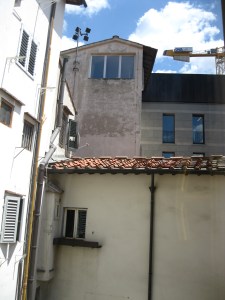
“‘She promised us south rooms with a view close together, instead of which here are north rooms, looking into a courtyard, and a long way apart. Oh, Lucy!'”  (Forster, 3)

IMG_6102

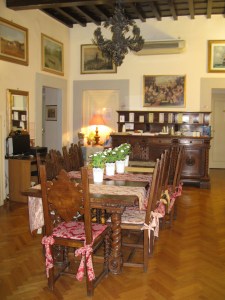
“She looked at the two rows of English people who were sitting at the table; at the row of white bottles of water and red bottles of wine that ran between the English people….” (Forster, 4)

Our pensione was not the Bertolini, which lay on the Arno River in the book. Nor did our room have a view, but that was probably best. We overlooked the Palazzo della Signoria and a restaurant occupied the bottom floor of our building and those around us. The crowds stayed up late — or early, depending upon which direction you approached the night. On our last night, a concert in the plaza did not begin until after 10 pm, then bells started ringing at 1 am.  The courtyard, too, was noisy with the restaurants closing. We were so tired from so much walking and wine that we slept through it all. Miss Bartlett, however, would probably have had an apoplectic fit!

IMG_6001

In truth, the guests did not eat together at this table, but the fare set out for breakfast was very like what one might find in England, although not a full English breakfast, with a little American expectation thrown in. The same could be said for the items found in the rooms.

Lucy regretted that their lodgings did not give her enough of the flavor of Italy, resembling England far too much to convince her that she had traveled abroad. How might she feel today? We certainly heard almost as much English as we did Italian. Yet, we also heard just as much French, German, Spanish, and multiple Asian languages about which I know so little that I could not distinguish one from another. All roads still do lead to Rome — and Florence and Venice. College students abounded, as well as the tour groups led by guides with their sticks  topped by flags or odd objects. Both could become tiresome, but Italian tour sites seem to have mastered the science of tourist traffic. No two groups in a room at once at any museum or in any plaza, it seemed, and they had to move at a steady pace.

We could manage the language barriers, mostly because of the linguistic skill of the Italians engaged in any sort of hospitality or tourism industry. The only problem we had was in Rome where our first hostess and I communicated mostly through primitive signing.  What we had a more difficult time managing was the cultural coffee difference.

Starbucks and its British cousin, Costa, have not migrated as far south as Italy, and you do not see Italians walking around with gigantic cups of coffee. Indeed, coffee comes in one size. If you stumble across the rare place that offers small and large, large is usually the size of an American small and simply means that they add more milk. This is because they see coffee as a nice snack of a beverage, like a small glass of juice with breakfast. We Americans are full-blown addicts.

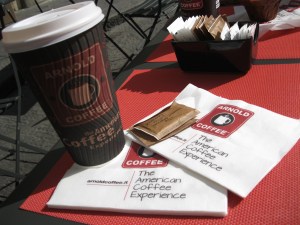
Fortunately, we stumbled across a place called “Arnold” in Florence. Arnold advertises itself as “the American Coffee Experience.” A large mural of New York City covers a wall inside and the set up resembles Starbucks or Costa more than an Italian coffee shop, with the exception of the outside seating area next to the Duomo. You can buy large, medium, and small (not tall, grande, and venti) coffee.

What I find funny, however, is that you can get an idea of the way one group of people views another by the way they try to replicate their conventions. Here, it is clear that Italians think Americans are serious sugar addicts. You could not get a cappuccino, only a flavored cappuccino. Even for me, with the taste of a six-year old at Halloween, it was on the sweet side. My three sugars self needed none and even then, I thought, “this is maybe a little too much.” The coffee wasn’t even that good, and I’m not a connoisseur by any means. I make a pot and will put it in the refrigerator and reheat cups all week until it is finished.

Still, we returned to that place again because they had big coffees. Sometimes, you just have to be you.

IMG_5897

Dystopian Bedtime Tales

This is actually a scheduled post, written before I find out about The Brain Tumor (which is not really a brain tumor) and before I go to New Orleans and before anything that will happen this week between the time that I am writing and the time that this goes up. There seems to be a bit of poetry in that.

The dystopian bedtime stories method of getting to sleep apparently still works. At least it did last night, when too many Cadbury mini eggs made me a bit jittery. Two outlines — actually, I’m not sure what you would call them, because anything more than seeds of ideas would probably be overstating the case. Anyway, two of these seeds came to mind.

In both Handmaid’s Tale and Children of Men, the social problem stemmed from the lack of children. Human reproduction had failed through virus in the first novel and — well, I haven’t gotten to the explanation in the second, if an explanation is forthcoming. In my vision, the problem goes in the other direction. Cutting off access to all reproductive services and outlawing all forms of mechanical contraception and sex education would lead to over population. Over population would lead to increased poverty, which would disproportionately affect women and their children.  Of course, education levels and professional employment of women would decline. What social services that remained would be overtaxed and collapse. Homelessness would increase. Extended families would be crowded into homes meant for nuclear families or apartments. Outlaw cooperative villages would crop up in marginal spaces.  Women would take any job available just to have the cash to buy food.

I fell asleep then.

The other seed involved the collapse of education, higher education in particular, which is a real fear in my life. It did not spin itself out quite as quickly, but that will be a Dystopian Bedtime Tale for another time, and I think would tie into the above tale in some way, if I’m building a world. After all, education is a female-dominated profession and devalued — literally de-valued — even at the college and university levels outside of the professional schools. The two would fit together quite well at a particular point in time in this world.

Indeed, for some women, they already do.


New Orleans Epiphany

I’m headed to New Orleans tomorrow for a conference. This is the first time that I’ve been there since 2001.

I took a boyfriend with me when I visited then. Not the boyfriend who is now the husband,  nor even the boyfriend who preceded the husband. The boyfriend who I took to New Orleans was the one who I am firmly convinced is a deeply closeted homosexual. He is also now someone else’s wife, god help her. God help her not because he is deeply closeted but because he is emotionally unavailable. And an ass. An enormous ass. An enormous, self-absorbed ass. His behavior in New Orleans revealed all of that to me and ended our relationship for the first time (first, because I am sometimes a slow learner); but he is a story for another time.

That 2001 visit, during the Christmas season, was my first real visit since 1994, if I’m not mistaken on the year.  Like now, the occasion for the 1994 visit was a conference, although the conference then was rather small, focusing on borderlands and Native American History, which was my specialty at the time. This was the type of small conference with no concurrent sessions.

A small conference like that would have been the perfect sort to network and make valuable connections and so forth, had I had the wit or mentoring to have taught me to do that sort of thing. I had neither. Indeed, I was there on my own dime and not at the urging of my adviser, who had not alerted me to this conference, and, had he known about it, would not have advised me to attend because he, too, was an ass. An enormous ass. An enormous, sexually harassing ass who had me trapped and gave me unethically bad advice.

Of course, I’m not sure that, even had I the wit or mentoring, that I was actually at a place in my life at that point to have networked and made valuable connections and so forth. I do know that this was the first time that I had been to New Orleans as an adult.

I had lived in Gretna for a couple of years at age 3 or 4, and then in Metairie from age 5 to 9, which seems like a long time in elementary school, being half of my life. Then, our parents disposed of us at our grandparents’ house there for ever longer summer visits, unfair to both us kids and the grandparents, until we all — kids and grandparents — could no longer stand one another for the familiarity. Then, we had the odd holiday visit here and there over the years. So, it wasn’t as if New Orleans was unfamiliar, but in the company of parents and grandparents, it isn’t quite the same. I was always the child, dragged about and fussed at. Furthermore, in 1994, I had only just recently allowed myself to actually become an adult in more than just years. I was, as they used to say, a late bloomer.

I can’t remember if I had learned of the conference from H or if I had learned of it and told him about it. Whatever the case, we both decided that we wanted to go and that we would share a hotel room to cut costs. I had hoped that he, being a former resident of New Orleans and something of a party animal, would show me some of its nightlife, this being my first trip to New Orleans, on my own, as an adult. He, partly in his casual way of humiliating me and partly in his not thinking about me at all, had instead made a date with an old girlfriend.

The relationship between H and I, in the broadest sense, was pretty fucked-up because we as individuals were fucked-up. H’s brand of being fucked-up meant that he abused people who cared about him and my brand of being fucked-up meant that I cared about people who abused me.  My brand of being fucked-up was also tied to an enforced naivete and immaturity, and much of knowing him had brought that to its end. My brand of fucked-up, in other words, had its limits, and he was reaching them.

The weather that weekend was fine. Crystal blue November, not too warm nor too cool, with the sun warm but the shade taking the edge off the hotter hours of the day. We left the first session, headed to lunch. I wanted a muffaletta from Central Grocery.

“I don’t want to wander around looking for a place to eat,” H moaned. I knew that moan. I hadn’t given him anything to moan about, but he was going to moan and then attack me for some reason or another.

“I know where I’m going,” I said.

“Well, I don’t have time to wander around looking for somewhere,” he replied.

“It’s just around the corner here,” I said.

“Look, you don’t know where you are going, I’m just going to go to the archive,” he said. He wanted to get rid of me anyway, that was clear. “I’ll see you at the session later.” He wouldn’t.

I was actually relieved. No one was more surprised about that than I was. This guy, one for whom I professed undying love for nearly two years, whose crumbs of attention I gladly accepted in spite of whatever insult or threat would come right after, who had at one time had seemed like the most exciting person I had ever met, whose attention I thought would somehow make me special, had finally struck me as a life-sucking, time-consuming bore. Not just in this moment, but empirically. He was boring. Mean and boring. I was relieved he was gone because he would ruin the fun I knew that was about to have. He always did. If, for one second, I had a moment of joy, he had to stomp on it and insult me. It took me almost another year to fully disentangle myself from him, but it began in the moment when I thought, “thank god he’s gone because he would ruin my day with his bullshit.”

I went to Central Grocery. I had a muffaletta for lunch, sitting on the riverside, watching the ferries. Then, I didn’t go back to the conference. The idea of spending such a glorious day in a darkened ballroom seemed such a waste, even if I had paid for the admittance. I walked all around the French Quarter, just looking to see. I’m sure I had a little swagger in my step. Those shoes always made me have one, but I felt it. I looked in shops, and danced to music, and sat in the sun. I may have returned for a  final session, but I don’t really remember.

I went to the hotel to change into less conferencey clothes, feeling fine. H was there, in a grump because his cologne bottle had broken and he smelled like a brothel. I tried not to laugh. He tried to get me to go hit on some National Guard guys staying in the hotel, all the while also insulting the National Guard guys.. He was always trying to get me to be promiscuous with men I didn’t want to sleep with, never with any success. Then he would insult me for being a prude. He went to his date, stinking to high heaven. I went back to the Quarter, to Preservation Jazz Hall, a pass through Pat O’Brien’s, and to more modern jazz and blues, and to all the things I had heard about and never seen. My goodness: go-cups! Who knew! I had a fine old time.

The next day, I did the same. As I wandered about, I had a revelation. At that point in my life, I did not really have that great of an interest in being a great historian. I mean, I did want to be a historian, but I’m not sure that I understood deeply anything about what that meant and I’m not sure that I could have articulated anything that I ask my students to consider today.  I had a sense that I was headed in the right direction professionally, but my ambivalence about an academic life had been growing in proportion to the amount of abuse I had encountered within it. If I could have discovered public history or museum studies or even archives at that point, I think I would be somewhere else today.

What I did understand in that moment of revelation, however, was that  I wanted to live a life that interested me. I hadn’t, to that point. In fact, I had lived a shamefully dull and sheltered life. Instead, I wanted to go different places and feel what I felt that day while wandering around New Orleans. I did not want to feel what I felt when I went back to Houston. I did not want to feel small, and stupid, like I was hiding in the past or in my studies, that, truth be told, were not really interesting me at that point. I did not want people in my life like H, who may have been interesting at one time in his life, which was my initial attraction to him, but who was now a ball of bitter, hateful, boring, blah.

I remember that thought, like a clear bell, walking down the street in the French Quarter. I want to live a life that interests me.

Waiting on the MRI Results

Monday turned up nothing. That is, the MRI did not turn up on Monday. I called at noon, not expecting anything but hoping to get on their radar quickly to get something by the end of the day.

Instead, the person who answered the phone said, “Friday? You had it on Friday? Well it is not here yet, so it is probably waiting for scanning and we have a backlog of scanning so it won’t be ready until Wednesday at least.”

Wednesday.

A more aggressive person would become grouchier, maybe be a bit more of a bitch, make noise. I’m not really like that, and what would that accomplish? My MRI is in their backlog. What makes me more special than anyone else in that backlog? Am I going to pitch a fit, demanding that they pull mine out (if that is even possible), pleading, “but thing is in my head, next to my brain!” So is everyone else’s thing. Some even have things in the main part of their brain. That’s this doctor’s specialty, things in people’s heads. I only have a possible pituitary microadenoma (not an actual Brain Tumor).

So, more waiting. Wednesday will be two and a half weeks since they first told me that one of my little gremlins took actual form and appeared on an MRI. Wednesday will be four and a half weeks since that first MRI. The first MRI was ordered back at the beginning of the semester, back when I was teaching about Napoleon, as I recall. We are now up to the Russian Revolution. The migraine that started this all took place on New Year’s Day. This has become a game of suspense.

My consolation is that this will not kill me. Not the waiting, not The Brain Tumor (whether it exists or not), not even the annoyance. It won’t even make me stronger.

I do think, however, that I should go out and buy some clay. I have a vision of my brain with the gremlin swinging from the pituitary gland as if he were Tarzan, laughing like a maniac. This is something that should be rendered in sculpture.

Dystopian Escape

The New York Times Books section has a story on a crop of dystopian books slated for release this season (I guess, it is a season?) At one point they quote a St. Paul bookstore manager, Matt Keliher, who says “People are finding comfort in dystopian books, or maybe more accurately, they’re finding answers in them.”

Well, no shit, Sherlock!

Seriously, I’m glad that I’m not alone in this, even at my advanced age.

I’ve been in an existential funk since about mid-October. Blame fall mid-terms, blame the election, blame the end of a project, blame my own chemistry, blame burn-out, blame whatever, but I have been down and haven’t been able to get up for very long since. Maybe for about three or four weeks at the beginning of the spring semester, but only temporarily. Joy comes in flashes, although I have no reason to complain. In fact, I have much to celebrate. Perhaps that is the reason that I find The Brain Tumor so funny.

In any case, in the midst of this funk last October, my husband, who is generally a joyful type of guy who, as he puts it, “likes happy” (which in no way explains his attraction to me), went out of town. I used his absence to watch American Horror Story: Roanoke. Normally, horror is not my thing. Suspense, yes. Gore, no. This, however, featured a historical element so, why not?

What a fucked up disturbing mess! I loved it! It was the perfect distraction for my distracted mind. The world in which it was set was so dark, so sick, so twisted, that it surpassed whatever phantom plagued my own mind and contained it in this controlled environment. It isn’t dystopian, but it might as well be. After all, it dealt with the ramifications of a reality show gone wrong. Or something. In any case, I began to realize that going dark — not just depressing, but dark — was comforting for a reason and in a way that it hadn’t been for a while.

The same went for Handmaid’s Tale, and now I’m getting into Children of Men, although it isn’t quite as satisfying just yet. I want something in which these terrible things are explored, but in the lab of fiction. Where the venality can be taken to extremes without actually hurting anyone, as a means to release the paralyzing parts of my dread.

Indeed, that was the way I dealt with most of the latter half of 2015 and all of 2016. I would tell myself dystopian tales to get myself to sleep at night. I’d take the news that infuriated me all day, and then I’d push it further in my bedtime stories. The creative instinct and control of the medium gave me the peace to fall asleep.

Yeah. Imagine my shock when some of my worst predictions came true and some I could not have imagined developed beyond. I can’t play that game anymore. Reality has surpassed my own limited skills.

But others are better. So I turn to them.

The Second MRI, this time with Contrast

I went in for the second MRI this past Friday

Two weeks have passed since the neurologist notified me of the pituitary micro adenoma otherwise known as The Brain Tumor. Intellectually, after obsessive Google searching, I know that this is nothing dire. Physically, I feel fine, except for the headaches. Emotionally? Good lord! That’s a whole different matter. That part of my brain functions on its own. It is the part that my mother used to deride as “Sarah,” after Sarah Bernhardt. It is the diva and the drama and the dread. That part of my brain has taken a whole lot of energy to keep under control and, at some points, has won.

During the first week, when I felt I should not let anyone know what was happening except my husband, I think about half of my energy went to maintaining a normal facade. In class, I had this almost physical sensation of sitting with my back against a glass wall. Behind the wall, Sarah Bernhardt threw a scene, complete with the gremlins, knocking on the window and shouting, “do you all want to hear something dumb? It’s quite hilarious, really!” I remember looking at a student speaking to me as if I were looking through binoculars, trying to pretend that nothing was going on behind me. I felt as if I were sitting in the front 1/10th of my brain with all of this other activity taking up the rest. By the end of the day, I was exhausted.

Finally, I gave in and let my friends and colleagues (but not students) know what was happening. That let off some of the pressure of keeping a secret. Still, at the end of the day I feel beaten. First, rage. Then, despair. Sometimes, if I’m lucky, a moment of “don’t give a fuck.” Not at The Brain Tumor, which still makes me want to laugh, but at actual things that do get me angry or sad regularly, but cranked up, and more so because I feel that I’m wasting time on thinking about them. What would I rather be wasting my time on? Not this shit. Not anger. Not despair. Not grading. Not other people’s bullshit. I also have to tamp down the joking because the husband doesn’t understand it.

Friday seemed like a nice beacon. A respite of some sort, although I don’t know what. Maybe because the MRI would offer more information that would lead to the next step, whatever that may or may not be. The puttering in place frustrates me. So, the MRI itself was a comfort, and the IV a real thing about which I have real anxiety that I could address. Being a baby about an IV is also something people can deal with. I can joke about it and people feel ok. It is communal. Laughing at the cosmic joke of a brain tumor to deal with it is a bit more individualized.

So, Friday, I worked out, ran four miles, did a yoga class, then went in. Filling out the same damn paperwork annoyed me. I wonder why they do that? Are they testing me? Do I have a tattoo now that I did not last time? The MRI tech, who looked a lot like my dad when he was in his fifties, only not as heavy, gave me a bit of a scare when he said they would give me a “shot” of the dye. I thought he meant an injection, and visions of gigantic needles poking me in my neck began to fill my head and all of that mental preparation gone for nothing. He reassured me that it was all an IV. He also reassured me that my sweat would not glow in the dark, nor would my spit, which was rather a disappointment. My urine wouldn’t even change colors.

The MRI itself was probably the high point of my week. Closeted there in that tiny space, even with the tube in my arm and the Sprockets Symphony playing around me, calmed me. I thought of a tv film about Temple Grandin, who forestalled anxiety attacks with a squeezing machine (which she modified from one that held cattle during castration, but whatever). I thought of being in a pod in a spaceship in a science fiction story, drifting among the stars. I hoped that this MRI would last a while.

Alas, it was over in about half an hour, if that long. I was out of the machine, the IV was out of my arm, and my scan would be out of the office by the end of the day. I can start pestering the neurologist tomorrow afternoon.


Moment of Futility #3 million

There is this student. Let’s say this is a composite student because, ultimately, this is a composite student. This student has taken classes from me for three, maybe four semesters. This student has also taken classes from other history professors for as many semesters plus two more. In all of these classes, this student has had to write research papers. In all of these classes, this student has been taught, told, and graded down for not following the instructions to follow a particular citation style that can be found on the library website, the address of which has been included in every syllabus, instruction sheet, and online component to every class. In every class, this student has been taught, told, graded down for not following instructions to cite the source of all information, not just quoted information. Said student persists in citing only quotations and citing them improperly, in spite of penalties.

Said student wants to be a history teacher. But, that’s not the point. I just bring that up because this is what brings that lovely sense of futility to my life, knowing that, in six to ten years this student’s students will be right there in my classroom doing the same damn thing.

Anyway. These are the little things that make me feel as if my life is one of futility.

Branwell Is the Reason We Can’t Have Nice Things

I hate when the loser men in the lives of women artists take over stories about the women and make the narrative all about the man and not about the artist.

Last night, PBS showed a docudrama — maybe the proper expression would be historical fiction film — of the Bronte sisters, To Walk Invisible.

This was a singularly unsatisfying bit of film. The actresses all played the sisters with deep passion, and you could see the likes of Jane Eyre and Wuthering Heights exploding from this Charlotte and this Emily. Yet, except for two poems by Emily, and the story that inspired her to write Wuthering Heights, very little of their literature came through. They did not sit down or walk or do anything and discuss the inspiration and evolution of their work. They discussed publication, but they did not discuss the creation. Mostly, the worried about Branwell.

The film opened with Branwell’s disgraceful return to Haworth and closed with his death. In between, the action propelled forward in response to Branwell. Branwell yelled, Branwell abused, Branwell drank, Branwell in all respects behaved like the worst sort of mean drunk for which you could have only flashes of sympathy. Branwell lumbered into each act, tediously taking it all over.

Perhaps that was an accurate sense of their lives, with them trying to live and him mucking up their peace and future. Perhaps the producers assumed the audience had deep enough of a familiarity with the Brontes’ work that we did not need to know about their process of creation and would capture the allusions. Perhaps the producers thought literary discussion would bore the audience. In the end, I loathed Branwell, and I loathed the producers for thinking so little of the sisters’ work that they could not, this film being a realm of fiction itself, bring us into the very conversations of creation in which these women gave meaning to this life.