I have three ideas for the Next Book. One grew out of the Last Book and has its own blog space elsewhere. One would be a YA novel written with my nephew. That may or may not end up being a blog post for another time and I would act primarily as his amanuensis. The third idea? Well, that’s the one for this blog space.
Little House on the Prairie. Yes. That’s the topic. Not Laura Ingalls Wilder, not a biography of her. That’s been done recently and done well. Besides, she doesn’t interest me enough to dig as deeply into her life as I did for the Last Book. No, I’m interested in the life of the story that she told.
I see the story as having several phases. First, of course, was the raw material that Wilder lived. That’s not so much the story as the raw data. The story itself begins with the telling and the purposes and contexts of the telling. I suppose the embryos of her journals and early columns play a part, but the first full version was her memoir, Pioneer Girl, published for the first time as a scholarly edition in 2014. Unable to find a publisher, she and her daughter, Rose Wilder Lane, herself a very successful novelist, revised the memoir, including a fictionalized account of Pa joining a posse to lynch a family of serial killers just to add spice. Then they aimed for a “juvenile” or children’s audience, and finally found success when Lane peeled off several of Pa’s stories and strung them together as little adventures amid the daily domestic workday of rural life.
The success of Little House in the Big Woods begins the second version of the story as a series of novels that progress from children to young adult. There is a lot going on in this version from the rather broad definition of “truth” used by Wilder and Lane in publicizing the books, to the two women’s anti-New Deal politics and Lane’s growing libertarianism, to the ways that they shift a western, Manifest Destiny narrative to the female point of view, granting equal importance to domesticity. In fact, I recently discovered that historian Amy Kaplan studied this concept of “Manifest Domesticity” in writing about the U.S.-Mexican War in The Anarchy of Empire in the Making of U.S. Culture (2002). (Why had I not learned of this idea before!!!) In re-reading the books, too, I’m discovering a tonal shift with By the Shores of Silver Lake that adds a grim element to counter much of the coziness that permeates the earlier books. Then, of course, the racial issues that are very much contemporary to Wilder’s childhood, and, truth be told, the time the books were written.
The third version of the story usually appears in the last few pages of the last chapter of most of the literature of Wilder and Little House. (This is also where I, as an interested little girl entered, but that shouldn’t be relevant.) Most of the scholarship coming from literary studies, you don’t see much appreciation for the television show; but, as a historian and as a child of the 1970s, I find both the genesis and Michael Landon’s interpretation fascinating. A whole chapter alone could be devoted to Pa and depictions of masculinity. (Heck, a whole chapter could be devoted to Michael Landon’s bare chest! Buff for the ’70s.) Attempting to translate nineteenth-century, rural gender roles into an era of women’s lib and a growing presence of women in the workplace became a problem, as did the depiction of race, which was often downright weird.
The show appeared in a landscape of television that included All in the Family, Charlie’s Angels, Roots, and The Waltons, in terms of historical fiction, topical series, depictions of women, nostalgia, and race. While Landon explicitly jettisoned the storylines of the novels, he returned to certain plot and historical points for material. Mary goes blind. Almanzo Wilder appears as a character at the proper point in Laura’s development. His siblings have historically accurate names. Laura has a little brother named Freddy who died as an infant, which she excised from the novels, and the Ingalls family moved away from Walnut Grove for a time to run a hotel, also excised from the novels. The storylines around these points, however, in no way resemble history or, when in the novels, those stories. So, all in all, Landon’s interpretation becomes both its own thing, but also something inspired by Wilder’s material.
The fourth incarnation has only appeared in fun memoirs of writers who have enough of a fascination with the novels to actually visit all of the sites that they depict, plus the historical sites. I confess that I want to do the same. Indeed, that was my initial idea for the framework of this book, which was not going to be what it is going to be now, until I found out that I was not the first, second, nor even third person to have the idea. Heck, I’m probably much further down the line than that, but three memoirs describing their author’s sojourns to the Little House sites have seen print. (Two of them are riotously funny and I want to become their author’s new best friend.)
I’ve actually been to the Laura Ingalls Wilder Museum in Mansfield, Missouri — where I had wanted to go since the age of nine when I learned that it existed. That had become a pilgrimage site during the life of Wilder herself, and her friends ensured that it would become sort of a shrine after her death. There seems to be a duality to the depictions of her in relation to Mansfield, but that’s probably another post for another time. The t.v. show revitalized interest in her books and, thus, interest in visiting the sites depicted in her books. Visitors led to a business around tourism. I know very little about this at the moment, but I’m interested in the ways that public expectations, the passionate debates about the extent of Lane’s hand in writing the novels, the influence of the television show, the historical record, and changing interpretations of her work and time affect the interpretations of the sites.
In a way, this public history site section wades into territory similar to the Confederate monuments debate. How much do you allow nostalgia and love of these novels and their author’s life to color some of the more complicated questions about it’s context, such as the settlement of the American Plains? You see that passionate debate in the American Library Association’s decision to un-name the Laura Ingalls Wilder Book Prize because of the racial attitudes reflected in her series.
(I can’t say that I disagree with the ALA decisions because, if you need to footnote your award to explain context, maybe you should just say it is an award for a best book and not name it after someone.)
Then, there is the fifth version, when the fans of the book series grew up, became academics and studied them as artifacts of American literature and culture.
The sixth, and perhaps more versions I haven’t yet sorted out. One of these would be called the “expanded universe” were it the Star Wars franchise. These include Roger Lea McBride’s novelizations of Rose Wilder Lane’s life, the mini-series novels of Wilder’s foremothers, and the more recent Caroline: Little House, revisited, and adult novel by Sarah Miller (which was very clever and quite excellent). This also includes counter-narratives such as Louise Erdrich’s Birchbark House, in which she re-visioned the historical period from the Native American point of view.
The children’s literature specialist at my college let me know there is a whole universe of erotic fan fiction surrounding the television series, usually pairing the young male characters. Then there is the Laura doll, made by a company founded to create more affordable versions of the American Girl types of dolls. Laura has a whole covered wagon with Jack (who is not brindle), horses, and camp equipment. (My 8-year old self has put it on her Christmas list to Santa.) Little House still figures into school curricula, and from what I understand is very popular with home schooling, because it lends itself to many subjects and activities at the elementary level.
So, what I see it that this story has resonance, and I’m curious as to the reasons for this resonance, and I’m also curious about the limits of the reinterpretations. How far can this story go? It has the verneer of domesticity that is appealing and can be cosy and privleges the women’s story; but it also advances certain ideas that sit uneasily in modern times and with modern sensibilities — at least liberal ones, but even conservative ones given some of the twists and collapses in the t.v. series. I don’t have an answer, but that’s where you start: with curiosity.
 The woman in bed one rejected her liver on Monday. Her best friend since high school, they were in the same sorority in college, sits sideways on the edge of her seat, elbow pressed on the arm of the chair. The lady in bed one’s son, lies back in another chair, one hand across his eyes. Both hold their phones.
 Define “better.” Here, “better” means “not as bad as yesterday” or “not as bad as when we got here” but it seldom means “all better” as in “well.” You have to know the specific points of reference to understand that the person whom you see before you is, in fact, “better.” Otherwise, you would not use that term. That term would never enter your mind for the state of the person you see in the bed.
 The question, “how are you?” loses meaning as you wait. The specificity of the context, the need to reassure people, the need to assess you own honest answer, render any answer inadequate. “Numb,” is mine.
 The waiting room for the friends and families of surgery and surgical ICU patients is perhaps the most uncomfortable place in the hospital outside of actually being in surgery or the ICU.
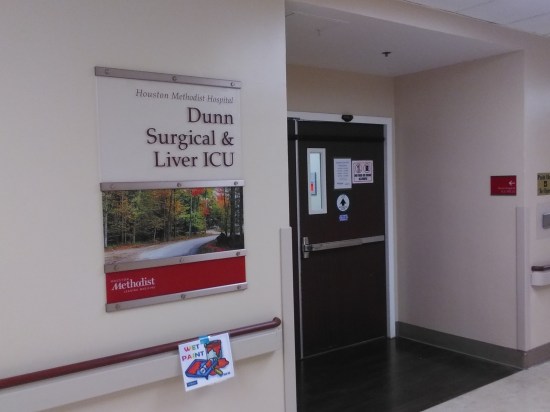 Intensive Care is purgatory, the waiting room for death, a never ending Judgement Day. Five beds crammed into one room for people who show up unscheduled. Three lined up from corner to corner along the wall across from the door, one to the right of the door beyond the hand washing station, and my father in the space just to the left. The dialysis machine and repirator take up the space between the bed and the wall. Computer carts skitter across the middle space, as nurses pilot around them.
 The Wuthering Mind