Awaiting the Shatter

IMG_3889You think through an opaque gel. Your sight narrows to a pinhole. You can barely comprehend that the letters form words that form sentences, much less wrap your mind around the argument that these papers try to make then dissect and critique them, give them feedback to improve. These are not metaphors so much as physical sensations. You eyeballs hurt. Your brain aches. The air itself does not have the strength to move this weight on your lungs.

Scholarly writing, the papers for conferences or for publication, elicit similar bodily responses. You have always said that the difficulty of academic writing lies in seeing something in three or even four dimensions but having to express it in the single dimension of the line on the page. Those three and four dimensions pull away from you in a blur, as if you have taken off your glasses. You cannot seem to find that place in your head where you store words. The capacity for concentrated, directed language has escaped you. The capacity for concentration has escaped.

You bleed ink into your journal, words to your therapist, shape this all into rants and jokes and reflections online. The deluge of sadness and rage sweep language through a gorge carved so deeply through the center of your being that the source itself has been overrun. Attempting to direct or stem the flood only forces the rage and sadness elsewhere with more power. The power exhausts you.

That crystal bubble in which you imagined yourself earlier in the fall begins to crack. The equal pressure from both inside and outside had maintained the tension that held the walls together. Now, inside has become stronger, you feel the stress increase, the surface cracking.

You await the shatter.

The Catastrophe of My Personality

IMG_3100Winter descends. The world outside your window becomes a black and white photograph. Your mood cycles from sad to mad to drunk. You don’t remember feeling good, having a purpose, hoping, so drunk provides the illusion. You wonder why you continue to live.

Your co-teacher tells the class about a psychiatrist who survived the Holocaust who would ask his patients “why haven’t you killed yourself?” Fear of the pain, you would answer. Fear of the pain in crossing over, which your dad had said that he feared, not death itself. Fear of the pain you would leave behind, which would be so much worse and so much more undeserved.

That still does not answer the question, why do you continue to live? You move forward on the energy of angry complaint, the listlessness of depression, the phantasm of intoxication. You aren’t living. You are wasting time.

Frank O’Hara comes to you in the voice of Don Draper.

Now I am quietly waiting for
the catastrophe of my personality
to seem beautiful again,
and interesting, and modern.

The country is grey and
brown and white in trees,
snows and skies of laughter
always diminishing, less funny
not just darker, not just grey.

It may be the coldest day of
the year, what does he think of
that? I mean, what do I? And if I do,
perhaps I am myself again.

O’Hara mourned the end of a romance, a lost love, but he described his loss in that balance between the specifically personal and achingly universal. In the full version of the poem, “Mayakovsky,” his fluttering heart of anxiety, his instinctual cry for his mother, his wish for one last moment, his begging for words to express this pain because he has no other ways of bleeding it from his body, the feeling of carrying a weight on his chest — these all come with grief. Then that last section, “always diminishing, less funny, not just darker, not just gray,” divorced from himself, awaiting some new sense of his place and the world.

You Were a Bad Daughter

IMG_2415The doctor asks, “Do you believe you were a bad daughter?”

“Yes.”

The truth, like a fist, hits you from the inside.

Yes. You were a bad daughter.

No one has asked this one simple question before. Your husband has reassured you that you were a good daughter, but he doesn’t know the whole story. Other people comfort you that he loved you, but that is not the point.

You were a bad daughter.

Lying in bed, forcing yourself to relax, forcing yourself to sleep, you realize that you don’t remember him. Not that you’ve forgotten him, but that you don’t allow yourself particular memories. A hint or flash will break through on occasion, but what you call remembering has more to do with a sense of him, his spirit or essence. You don’t allow yourself incidents or stories.  Those stories have love and anger and guilt and regret. They will bring you back to the realization: you were a bad daughter.

You will continue to be a bad daughter if you do not remember, if you do not etch these memories, the sound of his voice, the stories he told, the good things that he did or at least tried to do. Remembering has its own currents, riptides, waves, and squalls that require so many words, time to find the words, or time away from the words to just float in the feeling. Without the time, you hold off the memory and hate yourself more.

Yes. You were a bad daughter.

Muthaf****ing F-bombs

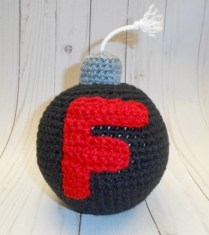
WhichCarrieFisherAreYouRemember, remember. November begins.  Your anger is the gunpowder beneath your daily Parliament, awaiting a Guy to set it off. A minefield floating beneath the surface of your thoughts: a mind-field. A string of lit firecrackers. A Bouncing Betty.

You pause to look up “Bouncing Betty.” The image comes to you from The Big Red One, but you aren’t certain exactly what it is. You would ask Dad. This is the sort of thing he would know. He’s no longer around to ask. If he was, you wouldn’t need to ask it. Turns out, the image you had in your mind of bomb, the size of a rubber ball, bouncing about until it bursts, is not quite what it is. What it is will still work: a shell that pops up to detonate.

You aren’t certain where these explosives lie. Trial and error has exposed the fuse to one or two, and you wish that you could warn people not to light them. Trial and error have  burned more than one.

Don’t, for instance, bring up the subject of eating. Perhaps the single up-side of these two months has been weight loss; but that is not the point. Eating, food, control, your parents, all of these things contain a particular combustible chemistry that is best avoided by anyone not professionally-trained in these matters. Worry more about the drinking, you want to say. You worry about the drinking, that’s for damn sure. (Not that you stop, you just create rules and a boozy character to play to hide the probability that you are a drunk.)

Don’t bring up, either, reviews of the other book, companion to your book. You look forward to reading that book, the parts that you have read are wonderful. You adore the author as a historian and personally. He’s a true mensch, a gentleman of the highest order. His book deserves prizes, awards, and positive reviews. His reviewers, who do give good reviews, are muthafuckas.

Men praising a second man for noticing the women in a third man’s life, and by implication praising themselves for noticing the same, then preening their knowledge of other books about the third man, fail to note that a book about the third man and women, written by a woman, was published last year. That book was not from an obscure press, it did win two awards, it was short-listed for a third, and it was reviewed by one of their peers in one of the major national newspapers. This sets you off. The cliqueishness, the boy’s club. You also hurt, knowing that your fifteen minutes of fame has ended, knowing that you are being ungrateful, unprofessional, petty, small, and yet still feeling as if you have some justification in your anger. The rockets red are glaring in your head and it may be the aura to a migraine.

You can’t even fathom the news rolling in from the election. The way that old male politicians receive praise as the coming saviors of one party while the women, with the same credential and same flaws, are told to shut up and sit down and go away for being so horrible and destructive we need new blood! The way that lies and slander and outright falsehood and corruption are hailed as signs of honesty and somehow representative of the Common Man and a change from the business-as-usual-Beltway-insiders. The clock turns back to 1950, to Jim Crow voter suppression without only a veneer of pretense that anything other than quashing democracy occurs. Your mind explodes at the hypocrisy, the cant, the sexism, and bullshit. “Muthafuckers!” you scream at any active screen. “Why are these muthafuckers still the Golden Boys?” You include the Left in this because all you see are white boys telling women to shut up, criticizing women who have been through far more shit than they have, backwards, in high heels, and having to anticipate the changes around them with a split second of warning. You love them for their passion and place in the world; but, goddammit, they are still muthafuckers.

You enjoy saying “muthafuckers.” F-bombs like the London Blitz blanket your vocabulary, but “muthafuckers” is really your favorite at the moment.F-BombCrochet
The troll lurks in the background, too. You love describing him as a “muthafucker.” He would be thrilled to know that he lights dynamite every day. He exploited your kindness, your friendship. Now he pisses on your work, calls you a racist, tries to align himself with women of color, although he is a white man, to get them to attack your work and to call attention to himself. He attacks kind scholars for failing to bow down to his one, thin, five-year old, publication from a print-on-demand press that had no context or his half-assed blog posts or his boast of his “scholarship” that more appropriately fall into the category of “antiquarianism” or his demands that everyone agree with him and follow his rules or be branded a “fraud.” He attacks as unscholarly for growing sick of his shit, his demands for accolades, and blocking him, as you did. You knew from the beginning of this phase that you would be happy to unload all of your anger on him, for yourself and for all of the people whom he attacks. Except you know that he is likely suffering from his own grief and this is his manifestation.

That doesn’t stop him from being a Muthafucker of the first order, as he probably always was. That doesn’t mean that you won’t strike back hard if provoked. That doesn’t keep you from hoping that you will be provoked because you want a muthafucker to hurt. Some muthafucker, any muthafucker, will do, so might as well be him as any other.

You almost call Thomas Jefferson a muthafucker in class. You think of Larry Wilmore saying, “Bill Cosby, I still haven’t forgotten about you, muthafucka.” You think the same of Jefferson. Then, you get to Andrew Jackson. He topped Jefferson in muthafuckerness. You bite the word off at the “f” in your lecture.  On stage, in class, this rage taken out on these white men who hated women, who hated African Americans, who hated Native Americans – all of whom comprise half of your class – focuses you, frees you, reshapes your lectures. Your evaluations will be dreadful and you don’t care. You see this part of history in a new light and it shines itself on this nation at the source of its myths.

You want a microphone and a spotlight. You want to turn your rage into a Lenny Bruce commentary — no, a Miriam Maisel commentary. This rage can feel powerful. It can feel like your car turning steeply on the edge of two wheels. It is the verge of losing control. It is knowing where the line of sanity lies, and choosing to cross it.

Except you aren’t always choosing to cross it. Then, it can feel like it will destroy you, explode you.

You can’t, after all, go around calling everyone “muthafuckers.”

Halloween Rituals

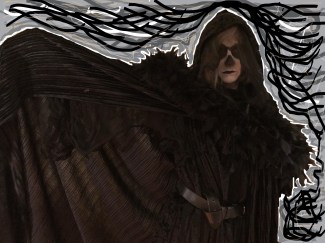
Angel-of-Death-Halloween2_LIHalloween arrives. The week before will not let you rest. A play, a movie, Pub Committee, a meeting, a this, a that, interact with people, be pleasant, be professional. You feel yourself a tightly winding coil in a glass bubble that stays together only because the increasing pressure inside matches the increasing pressure outside.

A party on Saturday night requires a costume. Feeling like the Spectre at the Feast, you decide to go as the Spectre at the Feast: the Angel of Death under layers of black fabric. Only the white make-up caking your face visible through a black veil. Putting together the costume concentrates your thoughts. You feel them moving together, cogs in relieving motion after so much grinding. Painting your face, ratting your hair, dressing all move you into a different part of your head, a different character, but something much more familiar, something that matches how you feel. At the party you take up a seat by the door, a dainty punch glass in hand. After a number of conversations, people leave you alone for the most part. You sink back into the black and buzz of alcohol, settling into the persona. People think you are a mannequin. You feel both invisible and present. You want to dress like this every day.

On Wednesday, you put on your t-shirt adorned with a graphic of a cauldron drawn with the words of the Scottish play’s Weird Sisters and you carve a pumpkin. Jack O’Lanterns are your yearly artistic endeavor and you look for inspiration in the grotesques of Bayeux cathedral. The process of sketching, creating the cartoon, gutting the pumpkin, carving it, sharing the work online, as you go. Another masterpiece of folk art! (You are the folk.) You wish you had more pumpkins, even tiny ones, to carve. You want to do this every day.

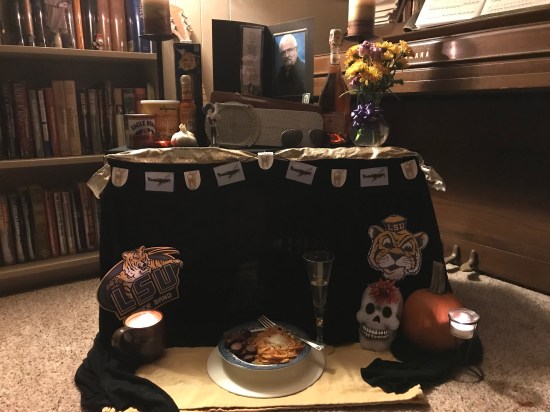
Thursday and Friday bring All Saints and Souls. You go to the grocery store with a list in your head: fried onions, condensed milk, garlic, spaghetti, sausage. What did he like to eat? What can you make in limited time? At home, online, you look dancing skeletons playing brass instruments and images of spitfires and tubas, LSU Tiger Band logos. You find a length of black fabric. Downstairs, next to your husband’s daughter’s old piano, on the piano bench and a dictionary, you make an altar for your dad. His picture at the top, the one used on the altar at his funeral (a smaller print, of course), candles, items from his pilot days, flowers, food, pictures of the things he liked. You think of him as you do this. What would he think of this? You talk to him a bit. You don’t think too deeply. Like Nick Adams and the muddy water under the trees, you aren’t ready to go there. You put all of that in a box, and you put whatever you IMG_3590can on top of it.

While you work on the altar, your cousin texts you. He never texts you. He wants to check to see if you will be in Houston for Thanksgiving. This was your dad’s last real request, made before he told you about his operation. You couldn’t even make a commitment to this. You certainly have now. This goes in the box.

When you are done, you play Elgar’s “Nimrod” and sit with your dad. The portrait has captured such an expression that you almost think his face moves, changes just slightly around the eyes, a line in the forehead, a shift in the muscles around his mouth. Not literally, of course, but the photographer – your mother – has managed to record a moment of complex emotions subtly rippling across his face.

Sunday is his birthday. Sunday is eight weeks from his death. Facebook reminds you of this first thing in the morning. (“Fuck you, Facebook,” has becoming your kidding-on-the-square mantra in these moments.) A glum pall hangs over the day. You realize that some people have not heard of his death as they wish him “Happy Birthday! Haven’t heard from you in a while.”

At some point on Monday, wandering through T.J. Maxx, seeing a bottle of White Shoulders that reminds you of the end of 8th grade, which leads you toward an uncomfortable thread of memory, the thought materializes that you had, in fact, expected your mother to go first. You realize that you had expected your father to help you through that. You hate yourself for having that thought. You fall into a conundrum that you don’t understand. You don’t even know the pieces of it, but the word “conundrum” sounds like the feeling. You feel the fragility of time and life, and you cannot touch either for fear that you will shatter them.

You feel a shift. Not for the better, a little for the worse, but mostly like turning a kaleidoscope. The pieces are the same, they just arrange themselves and the light differently.

Halloween and Dia de Los Muertos have given you rituals of a sort. They have allowed acceptable, recognizable, creative ways in which to express grief. They are holidays of mortality, morbidity, darkness, and shadows. You now enter the season of the merry holidays that celebrate light and impending hope. You feel a hole widening. You will be going in a different direction, down deeper, into a dark cave, toward that box you are afraid to open.

That box is guilt.

Last night you dreamed of him. Totally mortal yet floating. He was going to get a heart operation. You could see, in your mind, his arteries thin and shredded. You hugged him so hard. You can’t remember more than that, but you have the sense of a conversation. You think you told him, “I understand now. Everything you tried to tell me ever since I can remember, about regret, about choices, about time and love. I understand now.” You want to go back to that dream. You want to have the last, a last conversation.

You want his absolution.

IMG_3609

Slipping the “Surly Bonds of Earth”

IMG_1869Above England, the moon rolls off the silver edge of the wing. Behind the tail lies the ends of the day in a brilliant smear of sky.  You sail the mirror of stars above and lights below. The RAF poet whispers, “I have slipped the surly bonds of earth.”

The spirits of those pilots live out there in that glimmering air, if only in your thoughts of them. If such things as ghosts exist, would they bring along their Spitfires or would they prefer the sensation of pure, unadorned flight? What would your father choose? Surely he joins them, his heroes who took to these skies as he himself was born.

Out of the window you imagine him, the grey man you last saw, curled like a baby, dressed in blue, rising higher and higher to something greater than himself, until he, too, “put out my hand, and touched the face of God.”


Poem: “High Flight,” by John Gillespie Magee, Jr.

Edited 11/9 to change the picture to the one that I took from the plane over England.


Normalcy

IMG_2151“How are you?” is still a question that you don’t know how to answer honestly. You at least can lie and say “ok.”

You hate that question. What is wrong with a simple “hello” greeting? No one every really wants to know how anyone is, anyway, when they ask that question. Just say “hello,” dammit.

You must say “ok. I’m doing ok. And how are you?” You must smile. You must go to those parties and not be the spectre. You must reassure that, no, no, the reason that you are not there, if you are not there, has nothing to do with anything except that you are busy or some other plausible, understandable, acceptable excuse. You must squint your eyes while you are too much in the sun. You must reassure everyone that all is well.

You must go to work, you must grade those papers, you must do the things that you cannot concentrate on, although you cannot concentrate for more than two minutes. You must tear your mind away from him, from his loss, from this most essential thing, and the thing that most comforts you within this essential thing.  You must control your anger. You must not direct your anger at other people. You must apologize if you do. You must reassure people that anything disturbing is only temporary. You must not disturb them. You must contain yourself. You must perform normalcy.

At some point in one day, listening to the news, you decide that you do not want to exist. You don’t want to die. You certainly don’t want your husband, your mother, your brothers, the people you love, to go through this thing that you are going through and that they are already going through. You just don’t want this particular existence. You don’t want this pretension of normalcy that you must enact.  You will never be normal, if normal means like before. You will be something else.

Your blog posts keep coming back to the same theme. You are stuck in the same place. You must suspend yourself between the blog posts to play the normalcy game. You cannot move forward. This infuriates you. This fury is part of the stuck-ness. It is frustration. The rawness of your earlier posts came from the ability to write them in the moment, from the ability to write the emotion, from the ability to write. Now, you feel as if the urgency stales in between. You fear that your mind swoops in to protect you from the emotion that you so desperately want to record.

In recording you keep the connection to him, and you don’t want to lose that presence, his spirit still about you. You want to make it something beautiful. You want to hold it in place with words, capture it in the way that Victorians did with death photos or mourning jewelry.

You almost hope you do something drastic, something ridiculous, something that forces someone to step in and say, “you need help,” “you need a break,” “you need” what you scream for in the subtext.

The last time that you waited for someone to do that, you ended up boarding a plane and missing the last two weeks of your father’s life. You ended up doing the thing that capped all of the regrets of your life. You will regret it for the rest of your life. The stakes are not so high this time. You must adult, although you do not want to pretend this normal existence.

Six Weeks Out

BranaghHamletSix weeks since his death.

You are becoming an alcoholic. This develops not from a desire to drown your sorrows but from an inability to address them. There is this party. Another this Saturday. Another the next Saturday. Halloween festivities, plays to attend, deadlines that had extensions that required more extensions, papers to grade, classes to prepare. Your book is a finalist for another prize. Your book lives its best life. Yours proves a bit more complicated.

Everyone around you celebrates. You must not become the spectre at the feast. Everyone around you stresses. You just returned from three weeks Europe for a wedding and a conference. Who are you to wear black, now? To complain? The funeral is over. Time, distance, good news.

People ask how you are, “are you ok?” You feel as if they want reassurance that everything is back to normal, that the wound is healing. You try to be honest, you try not to worry them. You lie. You hate the armored shell that grows around you each time you do because it feels like a betrayal of him. It feels like it puts that same armor between you and your grief for him.

You feel like Hamlet at the beginning of the play: “I am too much in the sun.” (Hamlet is, at its core, simply a story about grief.)

Every morning you wake as if opening your eyes at the bottom of a lake. Watery anger and resentment envelope you, rise above you, compress and fill you. You drown in them.

This anger and resentment has its place along side the sadness. You welcome all of them. You would like to have a feast with these spectres. The purity of sadness rips open a chasm, dark and empty, but in it you connect to him, feel him close, concentrate your memory to gather moments and save them from this sieve that has become your mind.  You must sit quietly, alone, to do this. Instead, festivities, plays, deadlines, papers, classes, your book’s best life, too much in the sun. The interference feeds the anger.

Some of the anger has its own place; but, like the sadness, the anger cannot play itself out because of the aggravation of daily life. Worse yet, the anger drains you with the effort to contain it, to keep it from letting you do something self-destructive, to keep it from spilling on to other people, to keep from blaming other people, to keep from lashing out at people who only offer compassion and advice, or who simply cross your path at the wrong moment.

You want to shout to anyone in earshot to just stay out of your way, to just let you be angry, to not become road bumps in this thing you are enduring. Let you endure it. Let you wallow in it. Let you turn it into something else, something beautiful or terrible or useful or anything that does not fester or rot or dry up in a box in the back of your mind. Let you indulge yourself to find the creative rituals that will honor this pain that honors his life.

Instead, you must control yourself. You must control the anger. You must control the sadness. You must attend the festivities, the plays, the deadlines, the grading, the classes. You care less and less about these things. You care less and less about anything and everything that is not about grief. Instead of sad, you become numb. Becoming numb makes you sad, which then makes you angry, and then you must control your anger. Your anger grows, wraps itself into depression, frustration, exhaustion, borderline alcoholism. The alcohol, at least, wipes away the controls, the numbness, the frustration, and takes you down to the pure pain of loss. Only that purity can produce anything worthwhile.


The Ouija Board

ouijaDeath, reincarnation, extrasensory perception, anything supernatural and from the Great Beyond fascinated you and your friends in 7th grade, so Santa thought you might get a kick out of a means of contacting the Dead and brought you a Ouija board. Then your Jehovah’s Witness friend came over.

From the perspective and wisdom of many decades later, what transpired next makes sense. Every year before and after, this kid had to watch all of the other kids around her enjoy the cornucopia of Christmas as well as every other holiday in the Christian calendar while she had to go to “meeting” three times per week and didn’t even get to celebrate her own birthday. On top of that, the other kids, including you, were jerks about it. Heck, you were probably a bit of a jerk that day what with all of these nice, new things, some of which she coveted but you wouldn’t let her touch because, let’s be honest, your nice, new things usually didn’t remain nice, new things for very long in her hands. So, you can now understand that she would look for something to lord over you.

“You know those things only attract demons,” she said, pointing at the Ouija Board. “I can’t play with you anymore.” She stalked out of the house.

You would normally have thought your twelve-year old version of “well, fuck you, too.” This wasn’t your first time at her holier-than-thou rodeo. You didn’t even believe in demons. Just spirits. Instead, your dad found you in tears in your room. You honestly didn’t know what had so upset you, but it probably had something to do with feeling as if your loyalties had been torn. Torn between your different friends, torn between your parents and this friend, torn for some deeper reason that you still cannot fathom.

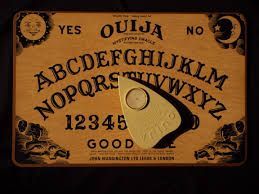
Was it this that prompted the séance? Or did the séance happen a few weeks later? In any case, you and your dad took out the Ouija Board and conducted one of the only two seances for which this one was used. Balanced between your knees, fingertips on the planchet, eyes closed. Did your dad ask the questions? “Is any spirit out there?” “Can anyone hear us?” “Answer us?” Nothing happened. You don’t think you actually thought it would.

When nothing happened, he told you that, when his time came, he would try to contact you from the Other Side and let you know what was there. This did not comfort you. This disturbed you. Not the Other Side part because that seemed exciting, but the dying part. The same stabbing in your stomach and tears that you had felt earlier came. You didn’t yet have the power to shut it off.

Now you do the math. Now you understand the way time passes for an adult. Granny, your dad’s mother had died when you were eight. Perhaps this séance had happened a few weeks after the friend had stalked out. If it had, perhaps it happened on the anniversary of her death in February. You won’t ever know now. In child time, four years might as well be an eon. When you are twelve, four years is a third of your life.

Four years for a man in his sixties is yesterday, and your grief for your Granny resurrected whenever your Grampy, your dad’s dad, visited. Your aunt, your father’s sister, once told you that he grieved as if no other man had ever lost his wife before. You have no way to measure this, to understand or evaluate this, as an adult. You do remember that his sadness draped all of his visits and made you relive her loss. He was visiting when the friend walked out, telling you that the Ouija board would contact demons. When he saw you crying, he asked, “a touch of the holiday blues?” You didn’t understand what that meant. You do now. You can hear the sympathy in his voice.

Four years for a man in his thirties is the day before yesterday, especially for a man who calculated, down to the minute, the moment when he would reach he exact age that his mother had been at the time of her death. He waited for that moment, expecting to die. He did not. Not then, anyway. He did not receive an epiphany, either.

When you arrived at your mother’s house on the day that he died, you went to her (already it is “her” not “their”) hall closet, pulled out the Ouija board, and set it up on the coffee table. They had moved three times since you were twelve. That they had kept this one thing of all things, used twice, stored in the attic or a closet for most of your life, seemed so bizarre and random.  You feel sharply that you do not believe in the Afterlife. “And this is the reason that people invented it,” you think as you sense the outlines of something hollow and finite in your guts. Still, you leave the board out overnight as a memorial to the memory and a dare to your lack of faith. You put it away the next day, disappointed that you are disappointed that you are disappointed that nothing had happened to change your lack of faith.

On the morning of his funeral, you think of this séance again as you shower. One of the lights in the bathroom flickers. Did you imagine it? No. There it goes. Flickering. A Morse Code. If it were supernatural, shouldn’t you feel something more, as if something momentous or frightening were happening? What if this is it? What if your lack of belief — and knowledge of Morse Code – prevents you from hearing his message? “This is the reason that people invented ghosts,” you think. The lightbulb burned out.

Since this ordeal began, so many people have said that they will pray for you. They mean it. They ask your name when they do not know you because they must say your name in their prayers. This sincerity astonishes and humbles you; but you cannot say the same in return, although you wish them love and the best possible outcome and that the person they love remain with them as long as possible with as little pain as possible. They may not share their love if they knew that you look to the end and see an end. When the minister speaks of grace being within God’s love, you understand why some theologians spoke of Hell being the absence of God’s love because you do not feel any sense of meeting those you love or have loved in some Great Beyond. These things are beautiful thoughts created to endure excruciating pain.

You just feel death as the end. The absolute end. No reincarnation. No heaven. No hell. No afterlife. No ghosts. No spirits moving planchets on a Ouija board.