Re-Reading The Handmaid’s Tale, pt. 1

“It made me so mad!” My creative writing class  was full of the “non-traditional” students that had always formed the majority who attended my university, and they seemed to be passing around this book like my seventh grade class had passed around Judy Blume’s Forever. 

“Me, too!” said another. “I gave it to my husband and he said ‘ah, so?’ and it made me so mad that he would act that way, ‘don’t you see how infuriating it is?’ I asked him.”

“What book?” I, the more “traditionally” aged student asked.

The Handmaid’s Tale,” they all chimed. I made a note. A book that had a room full of women this worked up must be good. Access to the New York Times Book Review was limited in those days before the internet, and pretty much a legend to me, so I learned of contemporary literature primarily through the Houston Chronicle Zest on Sundays or by wandering in bookstores to make note of books to find in the library or at Half-Price Books. Any recommendation was welcome, especially if it promised some dystopian feminist tale for my protofeminist mind. Fortunately, no one had checked it out of our university library. (Perhaps my peers did not read as much as we old folks now like to remember that our generation did.)

That was in 1989. I’d swear I had read the book again since, but don’t think I have, not even as an audiobook. In fact, I’m pretty sure I haven’t because I’ve decided to read it again. Too much recently in the news drew me to the story, and friends have shared previews from the new filmed version that have made me want to check my memory.

So, I pull out the paperback, which dates back to 1986 and which I bought at Half-price books for $2 in the 1990s, and I begin.

This Story Took a Strange Turn

“This is Tabitha,” the message said. “I’m calling about the results of your MRI. Please call me back.”

I did.

“How are you?” she asked.

“Fine, I hope,” I said. “You tell me.”

This started back on New Year’s Day. Actually, you could probably trace the migraines back to age six or even earlier, but this part starts with New Year’s Day. I woke with a headache, and while I had perhaps had a bit too much champagne the night before, this was worse than a hangover and it escalated as the day progressed. A workout did not help. A shower did not help. A nap did not help. The pain grew worse. Sometimes, throwing up takes the edge off of the pain.

Vomiting made the pain worse. An unrelenting pain, as if pincers squeezed the top of my brain.  I threw up the whole way to urgent care. The doctors there took care of the pain and recommended that I see my doctor, just to be sure. The revolving door of “my doctor’s” practice is a story for another time, but the nurse practitioner referred me to a neurology practice, just to be sure, where the aforementioned Tabitha, a physician’s assistant referred me for an MRI, just to be sure. This, after all, was probably one of the top three worst migraines that I’ve had in my life.

I’ve never had an MRI. I had a CT scan about maybe six or seven years ago when another migraine had me in the emergency room. Nothing showed up on that, so I joked to my husband and FB friends, “don’t worry, it’s not a brain tumor. It’s never a brain tumor. It only feels like a brain tumor.” That was the Monday before last. Tabitha called me yesterday.

“There is a 4 millimeter mass on your pituitary gland,” she informed me.

I almost laughed.

Then, I was curious. What exactly is a pituitary gland? What does it do? Where is it located? (Not at the base of you skull, as I thought, by the way, but right behind your nose.)

Also, I was relieved. Is there an actual cause for this pain I’ve suffered ever since I can remember? Probably not. Probably this was like the tumor they discovered on my brother’s thymus gland when they x-rayed him for a debilitating muscle spasm. Still.

In two weeks, I must go back for another MRI, this time “with contrast.” The worst part of that will be the IV. I’m not fond of IVs. I could only stand the one in the urgent care because it was less painful that my head. Also, based on this and a prior experience there, they are really good with a needle there.

I’m not worried. No, really! Most of what I’ve read on Dr. Google suggests that pituitary tumors give little cause for concern and the treatment is not at all as dreadful as you might think. But I’m walking around in this odd, half-daze of uncertainty. My response mechanisms feel in a state of suspended animation. “How are you?” “Oh, I possibly have a brain tumor. Yourself?” My husband is distressed,  and I feel for him. To tell anyone who cares about me would just traumatize them unnecessarily at this point. So, I’m holding it in because my honest-to-god gut response is entirely inappropriate. My reaction would, in fact, hurt other people, especially if this turns out not to be anything at all but a shadow on an image.

You see, I still want to laugh.

I want to say, “well, of course I have a brain tumor! Good things have been happening in my life so why wouldn’t I have a brain tumor?” I want to say, “want to hear something stupid? I might have a brain tumor!” A brain tumor, not a dangerous one, not a big one, just a small pituitary one that will probably be treated through medication or outpatient surgery is just so fittingly, ridiculously something that would happen to me and I want to laugh out loud about it.


Scenes after the Snowstorm

I don’t mind snow, when the world turns into a black and white photo. Deprived of all but summer, and a sweltering, unbearable, grey-white summer at that, for most of my life, a season of frost and muted sound continues to enchant me. Yet even in these near-arctic latitudes, winters grow short, condensed and hardened into a week. Months at at stretch go by with hardly a flake. A storm on Monday has melted by Thursday. This is unnatural in the most profound sense. Snow is water that melts into the lakes that keep our faucets flowing, our grapes growing, our wine in bottles, our tourists, our economies. Snow brings skiers. Snow feeds crops. A winter without snow is a drought of water and a drought of temperature. The forsythia have not celebrated spring for three years. How quickly seasons disintegrate, not one into another but as a whole. How many more winters will I see?

Social Justice Branding Fail

I work at a place that prides itself on its commitment to “social justice” and “looking forward” and a whole host of progressive values rooted in a particular religious tradition. Yet, I find myself constantly running encountering the reality that, while many individuals here might be, the institution treats social justice as a brand rather than an actual mission, especially the closer to home a situation hits. Help earthquake victims in Haiti? Sure! Address the complaints of your faculty of color? Let’s hold another meeting and have yet more “conversations.” Usually those conversations revolve around having more meetings to have more “conversations” that will do the same thing.

Meanwhile, the work of upholding civil rights law devolves upon already overburdened faculty and staff, either as yet another task dumped off on them or as another voluntary service obligation. The work of upholding civil rights law, usually overseen by whole offices or departments, is then decentralized and done by people who have “training” and “certification” but no real background or education. No attorneys or legal professionals enter in at any point. The school, however, can claim compliance.

Unfortunately, this means that neither the people who have grievances nor the people who are supposed to address these grievances know what to do when a situation arises. This can be something a big a outright discrimination or as routine as someone needing time off under the Family and Medical Leave Act (which is a whole other problem). As a result, the school is minefield of civil rights suits that even the person who graduated last in his law school class and barely passed the bar could win.

Yet, the powers that be seem unconcerned and even annoyed when this is pointed out, even when I gave evidence that the two similar institutions that they look to as guides have offices that deal with civil rights and diversity. Our powers that be want to either maintain the status quo or dump it all on HR, thus giving them the work of two offices.

There are moments when I teeter between, on the one hand, wanting to throw myself into the battle of making this a place that I can bear to work and that will take care of the people whom I enjoy working with, and, on the other hand, wanting to bury myself in my own privileges and say, “fuck this place. I’ll only invest in it what it invests in me, and that ain’t much.”

The Oppression of Time

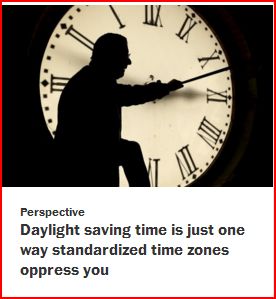
This headline from the Washington Post cracks me up: “Daylight Savings Time is Just One Way Standardized Time Zones Oppress You.” It reminds me of a late episode of Murphy Brown  (Season 8, episode 7, “The Feminine Critique.“) She went to speak to a women’s studies class, but when she showed up, no one was there. Gradually, the students began arriving late. “Where is everyone?” she wanted to know. “We’re never on time,” someone told her. “Clocks are a tool of the patriarchy.” I told my Women’s History class this story. This is now a running joke in the class whenever anyone is late.

OppressionOfTime