 Halloween arrives. The week before will not let you rest. A play, a movie, Pub Committee, a meeting, a this, a that, interact with people, be pleasant, be professional. You feel yourself a tightly winding coil in a glass bubble that stays together only because the increasing pressure inside matches the increasing pressure outside.
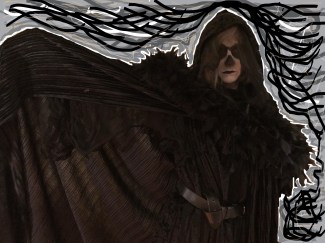
A party on Saturday night requires a costume. Feeling like the Spectre at the Feast, you decide to go as the Spectre at the Feast: the Angel of Death under layers of black fabric. Only the white make-up caking your face visible through a black veil. Putting together the costume concentrates your thoughts. You feel them moving together, cogs in relieving motion after so much grinding. Painting your face, ratting your hair, dressing all move you into a different part of your head, a different character, but something much more familiar, something that matches how you feel. At the party you take up a seat by the door, a dainty punch glass in hand. After a number of conversations, people leave you alone for the most part. You sink back into the black and buzz of alcohol, settling into the persona. People think you are a mannequin. You feel both invisible and present. You want to dress like this every day.
On Wednesday, you put on your t-shirt adorned with a graphic of a cauldron drawn with the words of the Scottish play’s Weird Sisters and you carve a pumpkin. Jack O’Lanterns are your yearly artistic endeavor and you look for inspiration in the grotesques of Bayeux cathedral. The process of sketching, creating the cartoon, gutting the pumpkin, carving it, sharing the work online, as you go. Another masterpiece of folk art! (You are the folk.) You wish you had more pumpkins, even tiny ones, to carve. You want to do this every day.
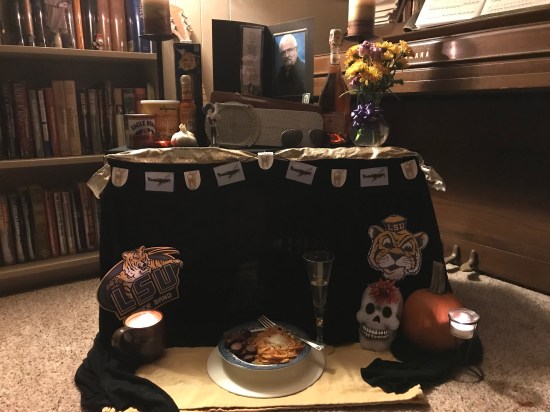
Thursday and Friday bring All Saints and Souls. You go to the grocery store with a list in your head: fried onions, condensed milk, garlic, spaghetti, sausage. What did he like to eat? What can you make in limited time? At home, online, you look dancing skeletons playing brass instruments and images of spitfires and tubas, LSU Tiger Band logos. You find a length of black fabric. Downstairs, next to your husband’s daughter’s old piano, on the piano bench and a dictionary, you make an altar for your dad. His picture at the top, the one used on the altar at his funeral (a smaller print, of course), candles, items from his pilot days, flowers, food, pictures of the things he liked. You think of him as you do this. What would he think of this? You talk to him a bit. You don’t think too deeply. Like Nick Adams and the muddy water under the trees, you aren’t ready to go there. You put all of that in a box, and you put whatever you  can on top of it.
While you work on the altar, your cousin texts you. He never texts you. He wants to check to see if you will be in Houston for Thanksgiving. This was your dad’s last real request, made before he told you about his operation. You couldn’t even make a commitment to this. You certainly have now. This goes in the box.
When you are done, you play Elgar’s “Nimrod” and sit with your dad. The portrait has captured such an expression that you almost think his face moves, changes just slightly around the eyes, a line in the forehead, a shift in the muscles around his mouth. Not literally, of course, but the photographer – your mother – has managed to record a moment of complex emotions subtly rippling across his face.
Sunday is his birthday. Sunday is eight weeks from his death. Facebook reminds you of this first thing in the morning. (“Fuck you, Facebook,” has becoming your kidding-on-the-square mantra in these moments.) A glum pall hangs over the day. You realize that some people have not heard of his death as they wish him “Happy Birthday! Haven’t heard from you in a while.”
At some point on Monday, wandering through T.J. Maxx, seeing a bottle of White Shoulders that reminds you of the end of 8th grade, which leads you toward an uncomfortable thread of memory, the thought materializes that you had, in fact, expected your mother to go first. You realize that you had expected your father to help you through that. You hate yourself for having that thought. You fall into a conundrum that you don’t understand. You don’t even know the pieces of it, but the word “conundrum” sounds like the feeling. You feel the fragility of time and life, and you cannot touch either for fear that you will shatter them.
You feel a shift. Not for the better, a little for the worse, but mostly like turning a kaleidoscope. The pieces are the same, they just arrange themselves and the light differently.
Halloween and Dia de Los Muertos have given you rituals of a sort. They have allowed acceptable, recognizable, creative ways in which to express grief. They are holidays of mortality, morbidity, darkness, and shadows. You now enter the season of the merry holidays that celebrate light and impending hope. You feel a hole widening. You will be going in a different direction, down deeper, into a dark cave, toward that box you are afraid to open.
That box is guilt.
Last night you dreamed of him. Totally mortal yet floating. He was going to get a heart operation. You could see, in your mind, his arteries thin and shredded. You hugged him so hard. You can’t remember more than that, but you have the sense of a conversation. You think you told him, “I understand now. Everything you tried to tell me ever since I can remember, about regret, about choices, about time and love. I understand now.” You want to go back to that dream. You want to have the last, a last conversation.
You want his absolution.
 The Wuthering Mind