Ah, but now we come to the Fourth Chapter. Alas, this is alas the final one about which I shall blog because the action leaves Florence and resumes in England while I moved on to Venice.
In the delightfully Victorian previous chapter, Lucy plays Beethoven triumphantly, making her “peevish” and unsettled with her insides churned. Mr. Beebe, through whose eyes we watch Lucy in that chapter, senses a sort of danger. “‘She oughtn’t really to go at all,’ said Mr. Beebe, as they watched her from the window, ‘and she knows it. I put it down to too much Beethoven.'”
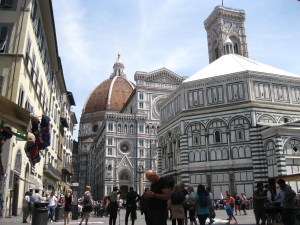
(This is just a picture of the Duomo because I don’t get to pictures for a few paragraphs. The Duomo doesn’t figure into the story at all, but it is such a fixture of Florence that I felt compelled to include it somewhere.):
In these days of all sorts of bombastic music, not just rock but the type of music that has to blow your speakers out with every single note, not to mention the singer’s vocal chords, that last sentence has a different meaning. I realized it some time ago, when I lost my taste for all of the music that used to, well, make me feel like Lucy after Beethoven. I lay on the couch listening to something classical. Perhaps it was Beethoven, or maybe Vivaldi. Like Lucy, I have very predictable tastes. In any case, I realized that the lack of words and the layers of emotions that accompany classical music can stir corners of your being that you may not know exist, and do so in combinations that you don’t expect.
For Lucy, Forster’s description of her understanding of music and art suggests that she approaches it much the way I did rock music when I was her age. Any stirring was something. So her encounter with Beethoven would have been much like mine with the Allman Brothers or Bruce Springsteen or really anything that shuffled off the ennui of suburban teenaged life. You feel alive in the music and you want to bring that feeling into your life.
So, Lucy goes out alone into Florence, uncertain how to bring that feeling into being except by riding on the electric tram, which she had expressly promised not to do. Her thoughts rebel against the nonsense of behaving “ladylike” while in this state:
It was not that ladies were inferior to men; it was that they were different. Their mission was to inspire others to achievement rather than to achieve themselves. Indirectly, by a means of tact and a spotless name, a lady could accomplish much. But if she rushed into the fray herself she would be first censured , then despised, and finally ignored. Poems have been written to illustrate this point.
Rumination on this passage must wait for another post, possibly many, because, while utter bullshit, women still live with the vestiges of these constraints. Obviously, this chapter stirs up much, and we aren’t even a full page into it.
As a pale substitute, Lucy defies propriety and purchases — gasp! — photographs of Botticelli’s “Birth of Venus,” naked as a jaybird on the day she was born, as well as several others that include a naked boy, a woman breastfeeding a baby, the Della Robbia babies that she so admired, that “Assention of St. John” over which the Emersons debated, and some Madonnas. “For her taste was catholic,” Forster comments, “and she extended uncritical approval to every well-known name.” We, of course, have already figured that out; and I find this painfully funny and familiar.
Then, the real action begins, just as she all but sings the chorus to the bored teenager’s lament, “‘Nothing ever happens to me.'” She enters the Piazza Signoria.


Through no coercion on my part or real intention beyond finding a comfortable, conveniently located, and reasonably priced room, we ended up staying on the Piazza Signoria. There, on the right, in the building with “Ristorante” on the ground floor, you can find our pensione. The piazza is now ringed with similar arrangements of ground floor dining and lodging above, with tchotcke booths near the Triton fountain. Tour groups come through like clockwork, pause in front of the Palazzo del Vecchio, snap pictures of the replica of David, and move on. Just as regularly, a horsedrawn carriage circles through. The horses wear little hoods to cover their ears so as not to become startled by all of the noise. As throughout the history of artists touring Florence, someone will forego the iPhone or iPad (or even the throwback camera) and study the statues on the loggia with pencil.
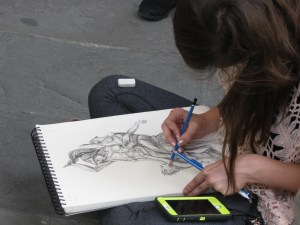
That is not me. Any drawing of my would be somewhat more abstract, perhaps even linear, if you catch my drift.
Lucy arrives at the palazzo in despair, her stirred soul disappointed, as the sun sets.
The great square was in shadow; the sunshine had come too late to strike it. Neptune was already insubstantial in the twilight, half god, half ghost, and his fountain plashed dreamily to the men and satyrs who idled together on its marge.


They were cleaning Triton, alas.
The Loggia showed as the triple entrance of a cave, wherein dwelt many a deity, shadowy, but immortal, looking forth upon the arrivals and departures of mankind. It was the hour of unreality — the hour, that is, when unfamiliar things are real. An older person at such an hour in such a place might think that sufficient was happening to him, and rest content. Lucy desired more.


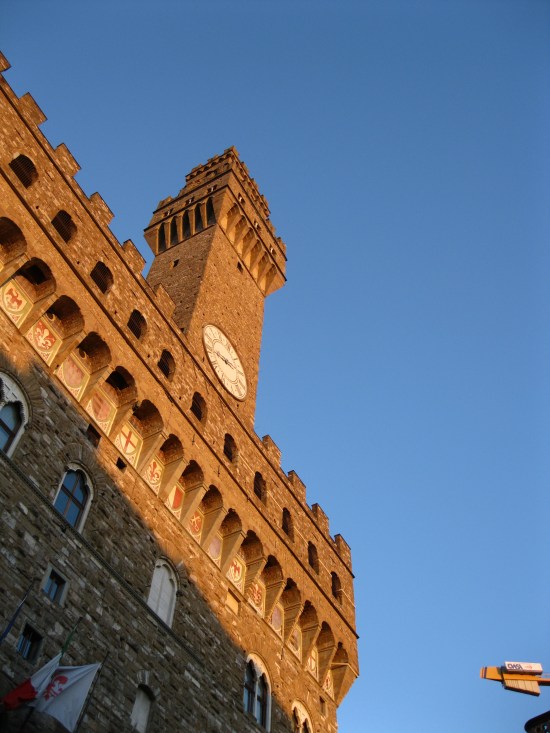
She fixed her eyes wistfully on the tower of the palace, which rose out of the lower darkness like a pillar of roughened gold.
Then something did happen.
 The Wuthering Mind