The tumbling baby brought the older Mr. Emerson into the scene. Both he and Lucy attempted to comfort the little tyke until his mother arrived. Once more, of course, Forster associates Lucy with babies, this one also breaking free from supervision. Lucy, now liberated from the influence of both Miss Lavish and Miss Bartlett, forms her own opinion of older Mr. Emerson (who I don’t believe ever receives a first name) and decides that she rather likes him and his son, George, for the time being.
Indeed, this thought begins to disturb her because “she was again conscious of some new idea, and was not sure whither it would lead her,” especially after George insists that she join the Emersons in the absence of Miss Lavish and her Baedeker. She tries to behave as she ought, turning coldly polite, but the older Mr. Emerson calls her on it. “‘You are pretending to be touchy; but you are not really'” he tells her, “‘Stop being so tiresome, and tell me instead what part of the church you want to see.” Thus, he forestalls what they call a “muddle” for the moment. Muddles are very significant in the story. They are that confusion between what you want and what you think you are supposed to want, like Lucy’s taste in art.
Lucy and the Emersons then make their way to her destination, the Giottos in the Peruzzi Chapel.
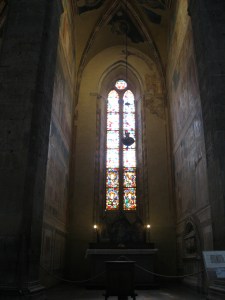
There, they run into the tiresome Rev. Eager. Stuffy Rev. Eager pontificated on the frescoes depicting the “Ascension of St. John” to a tour group that includes the elderly Miss Alan sisters from the Bertolini. He goes on and on about the church having been build with the strength of faith and his pronouncements that Giotto “is untroubled by the snares of anatomy and perspective” because the depth of his feeling transcends such foolishness.
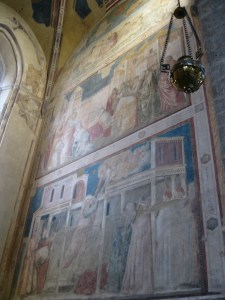
The older Mr. Emerson, “in much too loud a voice for church,” forever wins my admiration at this point by scoffing, “‘Built by faith indeed! That simply means the workmen weren’t paid properly. And as for the frescoes, I see no truth in them. Look at that fat man in blue! He must weigh as much as I do, and he is shooting into the sky like an air-balloon.'”
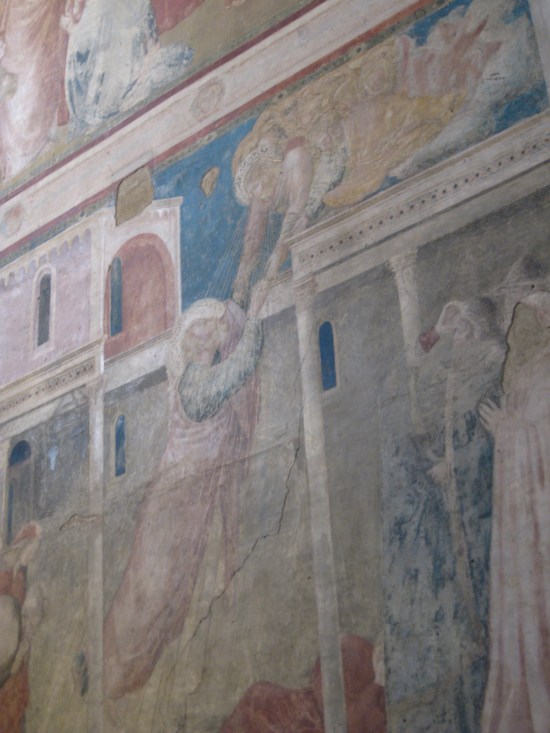
George disagrees. He prefers this mode of ascension, if such an ascension happened at all, because “‘I would rather go up to heaven by myself than be pushed by cherubs; and if I got there I should like my friends to lean out of it, just as thy do here.'” I must concede George’s point. Cherubs annoy me, too. Cherubs, incidentally, seem to be more baby imagery. George also ponders the grave out of which St. John rises, signalling his own suicidal ideation. He longs for an end to life while Forster associates Lucy with a beginning of life. Later, the older Mr. Emerson connects the two by referring to George as his baby whom he wishes would embrace life.
Their discourse, of course, offends the Rev. Eager, who has crossed theological swords with Mr. Emerson in the past. Now that I mention it, the crossed swords took place when George was, in fact, a baby. Eager insisted that an illness that George had suffered in infancy was punishment for his parents having not baptized him. Eager so worked on Mrs. Emerson, that she sank into a depression from guilt and died, seemingly from suicide. Mr. Emerson, then, had good reason to worry about his son, and Forster sets these pieces out here with the images of babies and graves and melancholy.
Meanwhile, Eager shuffles his crew out of the Peruzzi Chapel and into the next, which is filled with more Giottos, these depicting the death of St. Francis.
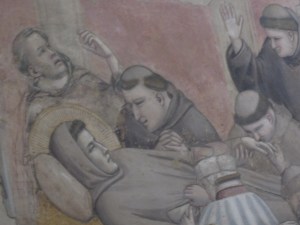
I just thought this guy was funny, as if he were saying, “get on with it already, Frank!”:

Mr. Emerson chases after them to apologize, leaving Lucy alone with George. She observes him as he paces the chapel.
For a young man his face was rugged, and — until the shadows fell upon it — hard. Enshadowed, it sprang into tenderness. She saw him once again at Rome, on the ceiling of the Sistine Chapel, carrying a burden of acorns. Healthy and muscular, he yet gave her the feeling of greyness, of tragedy that might only find solution in the night.
I think when I first read this book, I responded to George’s depression because I felt it myself. He seems a bit older than Lucy, or at least his stage of life would have been mine when I graduated from college a few years after I read the book, and I would certainly have understood that feeling of wanting more, wanting life, wanting feeling despite having all of the comforts that any person could possibly need. That, in fact, was the point when I began to long to visit Italy. Forster conveys that futile sense of desperation here in George’s description.
What I did not see the first time through the book or even the times I saw the film was the sex. Here it is. You have to go to images of the Sistine Chapel and look for the figure — or rather, figures — “carrying a burden of acorns.” They are the “Ignudi,” the nudes, muscular, wavy-haired, and beautiful, just the way Michelangelo liked them, who surround the main images of the Biblical stories. Although Lucy does not see the ceiling until later, off stage, while Cecil Vyse courts her, the seed — or acorn — has been planted here. The power of those nude male figures and the complexity of feeling elicited by George probably caused her muddle over Cecil in Rome when he proposed. How could she accept him with all of this sentiment so close to the surface? Only safely back home, ensconced in Windy Corners with no chance of ever seeing the Ignudi or the Emersons ever again could she consign herself to becoming the younger Mrs. Vyse.
Her skittishness emerges here, foreshadowing that silly yet dangerous engagement, when Mr. Emerson confronts her with George’s depression. He asks her to befriend the young man, to discover the source of his melancholy, and to help him find his way out. She retreats. The task is, perhaps, too much for her at this moment. After all, her own thoughts about George surprise her because, “it was unlike her to have entertained anything so subtle.” She lives life on the surface, uncertain of the depths even of her own self. She turns to the familiar, suggests a hobby for George, turns catty about the Misses Alans, snaps at Mr. Emerson, and becomes an echo of Miss Bartlett, who appears as her deus ex machina and whom she trots off to join.
“‘Poor girl,'” laments older Mr. Emerson. “‘Poor girl.'”
 The Wuthering Mind