Lucy and Miss Lavish finally arrive at Santa Croce.
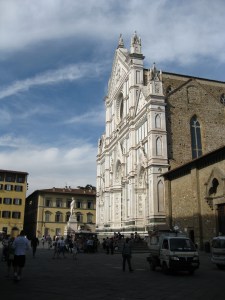
There they spy the Emersons entering the church. Miss Lavish makes the comment that she “would like to set an examination paper at Dover and turn back every tourist who couldn’t pass it.”
I confess to sharing her feeling at times, such as when we ended up seated next to the American frat jerk who seemed perplexed as to why girls hated him just before launching into a slut-shaming story about a young woman who orally gratified him — but that is a story for another time. Actually, I’m more inclined in my grouchier moments to issue a set of guidelines about considerate behavior, but that is also a story for another time.
Back to Lucy and Miss Lavish.
Miss Lavish abandons Lucy as she darts after “my local-colour box.” Lucy tarries outside in the square a bit, wishing she could remember which monastic order had built the church.
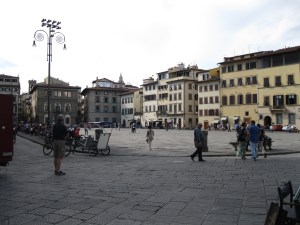
In her day, Lucy would have seen a statue of Dante in the middle of the plaza. That statue now stands next to the church entrance.
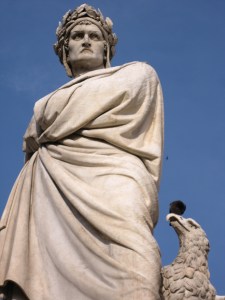
Very imposing!
Eventually, Lucy screws up the courage to enter the church on her own. Now, part of Lucy’s problem, with which I can wholly identify but don’t think I fully recognized the first time I read the book when I was much closer to Lucy’s age than the older Mr. Emerson’s, is that she finds herself caught between what she actually likes and what she is supposed to like. She knows that she likes the Della Roba babies in the Pallazza D’Annuziato and she knows that she like playing Beethoven sonatas triumphantly, but most other things she feels as if she ought to like in order to be cultured and sophisticated. That’s certainly how she reacts to the church. “Of course, it must be a wonderful building,'” she thinks,”‘But how like a barn! And how very cold!'”
While I wouldn’t go so far as to say the interior resembled a barn, I could see how the analogy might hold.
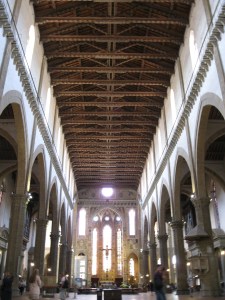
I also wished it were, in fact, cold since the weather outside had grown warm and we had been walking not quite so long as Lucy had, but for some time. Unlike people in Forster’s day, my definition of a cold interior has probably been affected by air conditioning.
Lucy assures herself that “of course, it contained frescoes by Giotto, in the presence of whose tactile values she was capable of feeling what was proper. But who was to tell her which they were?” Myself, I wasn’t all that interested in the Giottos because I had grown rather weary of religious subjects in paintings. One can only take so many annunciations and crucifixions, which seem to be the primary two subjects of Medieval and Renaissance art.
The main reason that I wanted to visit this church (outside of Jim Croce jokes) was, truth be told, to illustrate this blog as I did with Dracula and Whitby last year on Facebook. That Machiavelli was interred here had an added bonus for me not only as a site but also as a lure to convince my husband that this was a good place to visit. He hasn’t read Room With a View nor has he seen the movie in many years (although I could swear we watched it together not too many years ago).
In fact, I only knew that Machiavelli’s tomb lies in the church because of Lucy’s next encounter as she wanders about looking for the Giottos.
She beheld the horrible fate that overtook three Papists — two he-babies and a she-baby — who began their career by sousing each other with the Holy Water, and then proceeded to the Machiavelli memorial, dripping but hallowed. Advancing toward it very slowly and from immense distances, they touched the stone with their fingers, with their handkerchiefs, with their heads, and then retreated. What could this mean? They did it again and again. Then Lucy realized that they had mistaken Machiavelli for some saint, hoping to acquire virtue.
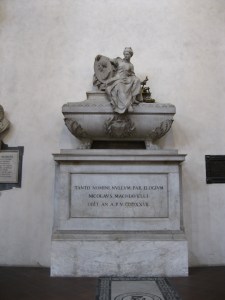
As for my husband, I managed to get him to the square for a drink in a cafe the day before in our own wanderings, then persuaded him that we should eat at one of the restaurants the next night. Meanwhile, I found information that informed me that — what do you know? — Michaelangelo,
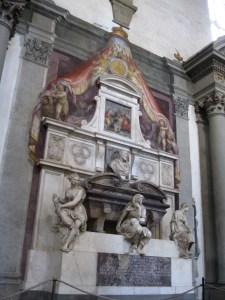
(notice how the statue on the left has her own little sculpture)
Dante,
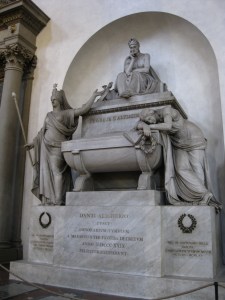
and Galileo
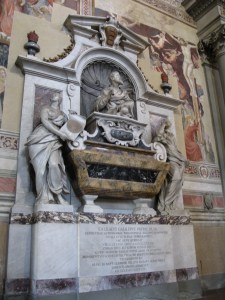
are also buried there. This all allowed me to entice him to visit the inside of the church. Once we got there, we discovered Da Vinci
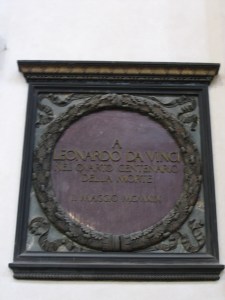
and Marconi, although he would not have been there when Lucy visited.
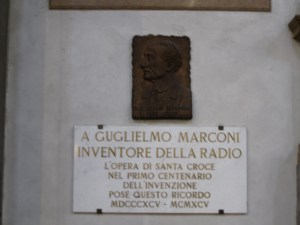
As I read the novel before I trip, I did not entirely understand the next incident.
The smallest he-baby stumbled over one of the sepulchral slavs so much admired by Mr. Ruskin, and entangled his feet int he features of a recumbent bishop. Protestant as she was, Lucy darted forward. She was too late. He fell heavily upon the prelate’s upturned toes.
What was happening? Was the bishop lying down on the floor? Was he alive or dead? Lucy calls him “hateful” in the next paragraph, but to his face? He seemed to have been made of stone.
He was. She referred to one of these interesting slabs on the floor of the church on which the departed have been carved in relief.
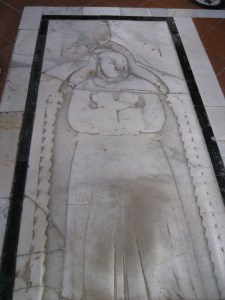
Most are worn flat, as this one is; but they may not have been quite so worn in the early 20th century, or Forester could have taken a little dramatic license. So, too, a slight bump becomes a mountain to a small child.
I am still ignorant of the Ruskin to which Lucy refers repeatedly in the chapter. I suppose I could go look it up, but there never seems to be enough time to do the things you want to do once you find them.
 The Wuthering Mind