“It was pleasant to wake up in Florence….to fling wide the windows, pinching the fingers in unfamiliar fastenings, to lean out into sunshine with beautiful hills and trees and marble churches opposite, and close below, the Arno, gurgling against the embankment of the road.”
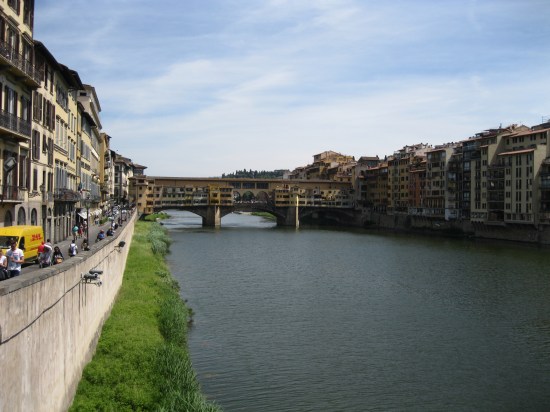
Lucy and Charlotte’s pensione, the Bertolini, would be much further down the river, past the Ponte Vecchio depicted here in this image. Past, even, the Uffizi, which lies beyond. Forster set the Bertolini on the edge of the area now frequented by most tourists — or at least by me — from what I could tell from the description of Lucy’s outing in this chapter.
After awaking and having a tiresome scene with the ever-passive aggressive Miss Bartlett, Lucy finds an enthusiastic guide to the Santa Croce church in the “clever lady” Miss Lavinia Lavish. Miss Lavish eschews the Baedeker’s guide, the Bible of all Grand Tourists. “”He does but touch the surface of things!” she proclaims. Indeed, he does, but the Baedeker’s guide made such a tour more accessible to the middle classes so parodied by Forster, Twain, and other writers, who, in turn, are parodied in the figure of Miss Lavish.
Thanks to digital humanities projects, we travelers today can take a look at the Baedekers used by those nineteenth century Grand Tourists. When you read them, with their recommendations for restaurants and pensiones and hotels, as well as their histories of the cities and countries on the tour, you feel a kinship if you have ever turned to a Lonely Planet or Top Ten or any other of today’s travel guides that you use to orient yourself in a strange land, especially one in which you do not speak the native language. If you use your imagination and think that, in the nineteenth century, they had much less information and much less cultural globalization, you can feel even a greater sense of adventure and alienation in stepping into those distant places. Forester mocks these tourists a bit, with their Baedekers and their Anglican minister tour guides like Rev. Eager and their very English pensione, but like my need for a very large coffee, travel can be disorienting. You want to orient yourself however you can, and sometimes you need a touchstone.
Maybe I’m being hard on Forester in mocking the Baedeker crowd. He does, after all, later show the elder Mr. Emerson sympathizing with Lucy in the loss of her Badekker. When Lucy complains that “‘Miss Lavish has even taken away Badeker.” Mr. Emerson — who will always be the darling Denholm Elliot in my mind, thanks to the film — replies, “‘I’m glad it’s that you minded. It’s worth minding, the loss of Baedker. That’s worth minding.” Sure, Mr. Emerson seems teasing, but he’s kindly teasing, and understands.
Back to the beginning of Lucy’s outing. She and the Baedeker-confiscating Miss Lavish start out on their journey, with Miss Lavish’s promise, “‘I will take you the dirty back way, Miss Honeychurch, and if you bring me luck, we shall have an adventure.'” “Adventure” is a word that can be used much like the American Southern expression, “bless your heart.” Lucy, in her youth and naivete, makes the mistake of thinking this will be joyful. As the entirety of the novel demonstrates, adventure might be “very interesting” and exciting, but it is not always joyful. Quite often it is confusing and painful and can cause you to make disastrous decisions because they feel familiar and safe.
So, what happens when Lucy relies upon Miss Lavish?
“Miss Lavish — for that was the clever lady’s name — turned to the right along the sunny Lung’Arno. How delightfully warm! But a wind down the side streets cut like a knife, didn’t it? Ponte alle Grazie — particularly interesting, mentioned by Dante. San Miniato — beautiful as well as interesting; the crucifix that kissed a murderer — Miss Honeychurch would remember the story….”
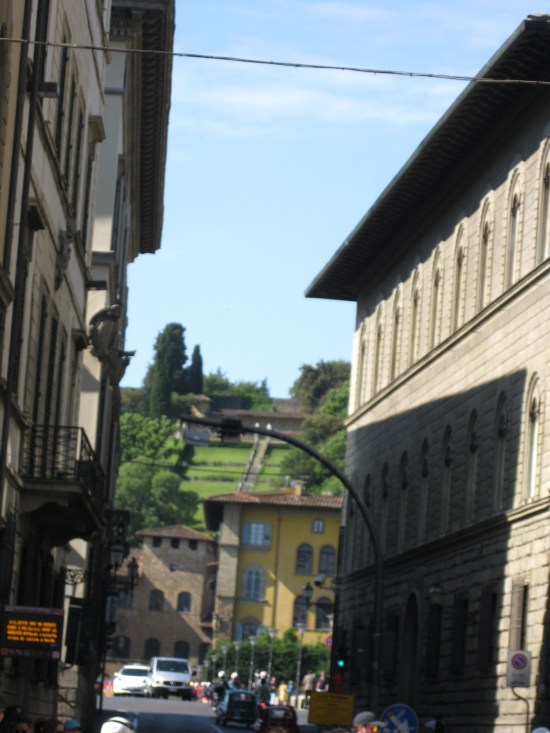
Alas! As Miss Lavish points out the site across the river, then instructs Lucy to inhale “a true Florentine smell!” she entirely misses the turn to Santa Croce, which would be down this very street. They end up wandering and wandering, discussing matters of home, which do always seem to intrude, even when you are abroad and especially if you run into people from home.
At least, in my experience, those matters can seem so far away and less urgent, or perhaps that is a testament to my own powers of denial as long as I keep moving. Indeed, at some point on this trip, in Florence, I understood the reason that so many poets and writers and artists left home to seek refuge in places like Italy. Sometimes you have to step outside of your own life to feel alive. You have to feel alive to find your way back to that place in your head or your being that allows you to create.
In this novel, Lucy’s makes a journey of a young and repressed woman. She must find her way to simply feeling alive. This wandering with Miss Lavish begins that journey. They, of course, end up far off course, and fortifying themselves on some vile concoction that “tasted partly of the paper in which it was wrapped, partly of hair oil, partly of the great unknown.” Yet, Lucy did have one revelation.
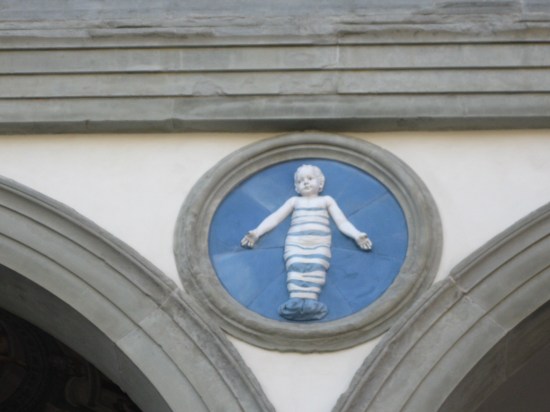
“For one ravishing moment Italy appeared. She stood in the square of the Annunziata and saw in the living terra-cotta those divine babies whom no cheap reproduction can every stale. There they stood, with their shining limbs bursting from the garments of charity and their strong white arms extended against circlets of heaven. Lucy thought she had never seen anything more beautiful….”
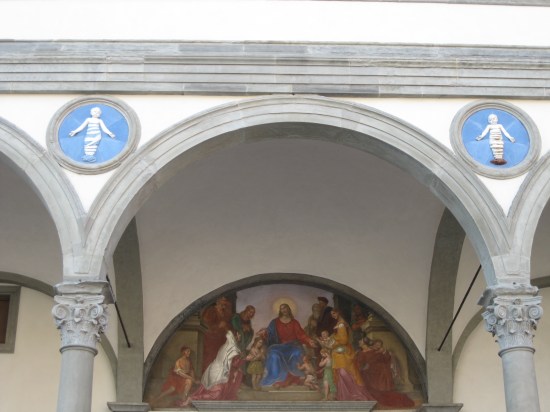
I confess that was not how I saw them. Twee, sentimental, innocuous — all of these words came to mind. I also thought that, perhaps, this is the sort of thing a pleasant but unremarkable young woman like Lucy would like. In the next chapter, Mr. Beebe describes her as “only a young lady with a quantity of dark hair and a very pretty, pale, undeveloped face. She loved going to concerts, she loved stopping with her cousin, she loved ice coffee and meringues. He did not doubt that she loved his sermon also.” Of course she likes babies, too.
I wondered also, if this passage were also telegraphing her future. After all, as I thought about the ending of the book (is it really a spoiler to reveal the ending of a book that is over a century old, adapted as a movie that is now over 30 years old?), I thought it rather sad that perhaps this story is the high point of Lucy’s life and the most exciting thing that will happen to her. She and the young Mr. Emerson marry. The young Mr. Emerson is solidly in the middle class, holding a solid, middle class job in a bank, and in the last scenes, Lucy is engaged in something so domestic as darning his sock. They do a lot of kissing, so we can probably presume that the start on making a baby there in the Bertolini overlooking the Arno. Thank goodness Forster’s generation saw no need for sequels because we can see the very dull, bourgeois life they will enter, considering the deep passion that the story has called upon to this point. It seems, indeed, a repudiation of the repudiation of passionless bourgeois life that has been the message of the book. (Or is Forster just calling for a bourgeois life that includes passion?)
That’s one way to read it, which is colored by my own feelings toward that sort of domesticity. Another, within the scope of the covers of the novel and its story of passion, lies in Lucy’s description of these babies. She identifies with them. She is the baby bursting out of swaddling and reaching out her arms. Her interpretation is one of liberation, and the passage has a breathless quality to it (or so I imagine).
Then, Miss Lavish drags her away.
 The Wuthering Mind