“‘She promised us south rooms with a view close together, instead of which here are north rooms, looking into a courtyard, and a long way apart. Oh, Lucy!'” (Forster, 3)
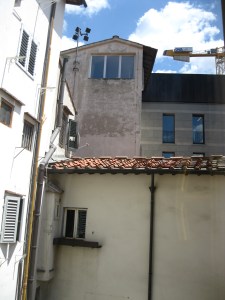
“She looked at the two rows of English people who were sitting at the table; at the row of white bottles of water and red bottles of wine that ran between the English people….” (Forster, 4)
Our pensione was not the Bertolini, which lay on the Arno River in the book. Nor did our room have a view, but that was probably best. We overlooked the Palazzo della Signoria and a restaurant occupied the bottom floor of our building and those around us. The crowds stayed up late — or early, depending upon which direction you approached the night. On our last night, a concert in the plaza did not begin until after 10 pm, then bells started ringing at 1 am. The courtyard, too, was noisy with the restaurants closing. We were so tired from so much walking and wine that we slept through it all. Miss Bartlett, however, would probably have had an apoplectic fit!
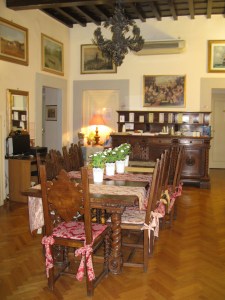
In truth, the guests did not eat together at this table, but the fare set out for breakfast was very like what one might find in England, although not a full English breakfast, with a little American expectation thrown in. The same could be said for the items found in the rooms.
Lucy regretted that their lodgings did not give her enough of the flavor of Italy, resembling England far too much to convince her that she had traveled abroad. How might she feel today? We certainly heard almost as much English as we did Italian. Yet, we also heard just as much French, German, Spanish, and multiple Asian languages about which I know so little that I could not distinguish one from another. All roads still do lead to Rome — and Florence and Venice. College students abounded, as well as the tour groups led by guides with their sticks topped by flags or odd objects. Both could become tiresome, but Italian tour sites seem to have mastered the science of tourist traffic. No two groups in a room at once at any museum or in any plaza, it seemed, and they had to move at a steady pace.
We could manage the language barriers, mostly because of the linguistic skill of the Italians engaged in any sort of hospitality or tourism industry. The only problem we had was in Rome where our first hostess and I communicated mostly through primitive signing. What we had a more difficult time managing was the cultural coffee difference.
Starbucks and its British cousin, Costa, have not migrated as far south as Italy, and you do not see Italians walking around with gigantic cups of coffee. Indeed, coffee comes in one size. If you stumble across the rare place that offers small and large, large is usually the size of an American small and simply means that they add more milk. This is because they see coffee as a nice snack of a beverage, like a small glass of juice with breakfast. We Americans are full-blown addicts.
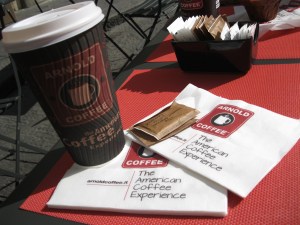
Fortunately, we stumbled across a place called “Arnold” in Florence. Arnold advertises itself as “the American Coffee Experience.” A large mural of New York City covers a wall inside and the set up resembles Starbucks or Costa more than an Italian coffee shop, with the exception of the outside seating area next to the Duomo. You can buy large, medium, and small (not tall, grande, and venti) coffee.
What I find funny, however, is that you can get an idea of the way one group of people views another by the way they try to replicate their conventions. Here, it is clear that Italians think Americans are serious sugar addicts. You could not get a cappuccino, only a flavored cappuccino. Even for me, with the taste of a six-year old at Halloween, it was on the sweet side. My three sugars self needed none and even then, I thought, “this is maybe a little too much.” The coffee wasn’t even that good, and I’m not a connoisseur by any means. I make a pot and will put it in the refrigerator and reheat cups all week until it is finished.
Still, we returned to that place again because they had big coffees. Sometimes, you just have to be you.
 The Wuthering Mind